
You just got a new lead. Great! But all you have is a name and an email address. Now what?
You're looking at a puzzle piece, not the full picture. Is this lead a student kicking the tires, a small business owner, or a key decision-maker at a Fortune 500 company? Without that context, you're flying blind. Your attempts at personalization will feel generic, and you have no real way to know if this lead is even worth a salesperson's time.
This is exactly the problem company data enrichment was built to solve.
What Company Data Enrichment Really Means
Think of data enrichment as the process of taking that single puzzle piece, your raw, incomplete customer data, and instantly finding all the other pieces that connect to it. It’s an automated way of adding layers of valuable, publicly available information to the basic records you already have.
Instead of just a name and email, you suddenly have a rich, detailed profile packed with business context. It transforms a basic sketch of a customer into a full-color portrait, giving your sales and marketing teams an actionable, complete picture to work with from the very first touchpoint.
Turning Raw Data Into Actionable Insight
The change from a raw lead to an enriched one is night and day. It’s the difference between guessing who your customer is and knowing who they are.
For instance, a raw lead might just be "jane.doe@examplecorp.com". After enrichment, you now know Jane Doe is the VP of Marketing at ExampleCorp, a 500-employee SaaS company in the fintech space that just closed its Series B funding. That context changes everything.
An enriched profile allows your teams to stop operating on assumptions and start making data-driven decisions. It’s the foundation for real personalization, smarter segmentation, and effective lead scoring.
This shift from guesswork to insight is why the data enrichment market is booming. Valued at around USD 2.08 billion, it's projected to nearly double by 2032, driven by the intense demand for better personalization and the rise of AI. You can dig into the numbers yourself by exploring the full data enrichment market research.
From Raw Data to Actionable Insight
To really see the impact, let's walk through a practical before-and-after. The table below shows just how dramatically a single company record can be transformed, turning a few sparse data points into a powerful asset for sales and marketing.
| Data Point | Before Enrichment (Raw Data) | After Enrichment (Actionable Insight) |
|---|---|---|
| Company | ExampleCorp | ExampleCorp Inc. |
| Industry | Unknown | Financial Technology (Fintech) |
| Size | Unknown | 500-1,000 Employees |
| Location | Unknown | San Francisco, CA |
| Tech Stack | Unknown | Salesforce, HubSpot, AWS |
| Socials | Not Available | LinkedIn, Twitter Profile URLs |
| Website | examplecorp.com | https://www.examplecorp.com |
| Logo | Not Available |  |
This isn't just more data, it's clarity. With this level of detail, your outreach can be timely, relevant, and far more likely to get a response. You're no longer just another email in the inbox; you're a partner who understands their business.
The Building Blocks of Enriched Data
Effective company data enrichment isn't magic; it's about layering the right information together. Think of it like building a house. You can't put up walls without a solid foundation. In the same way, you can't build a strong data profile without the right building blocks. Get it wrong, and you're left with a wobbly structure that won't support your business goals.
The whole point is to turn scattered, raw data points into a cohesive profile that your team can actually use. This is what that transformation looks like in practice:
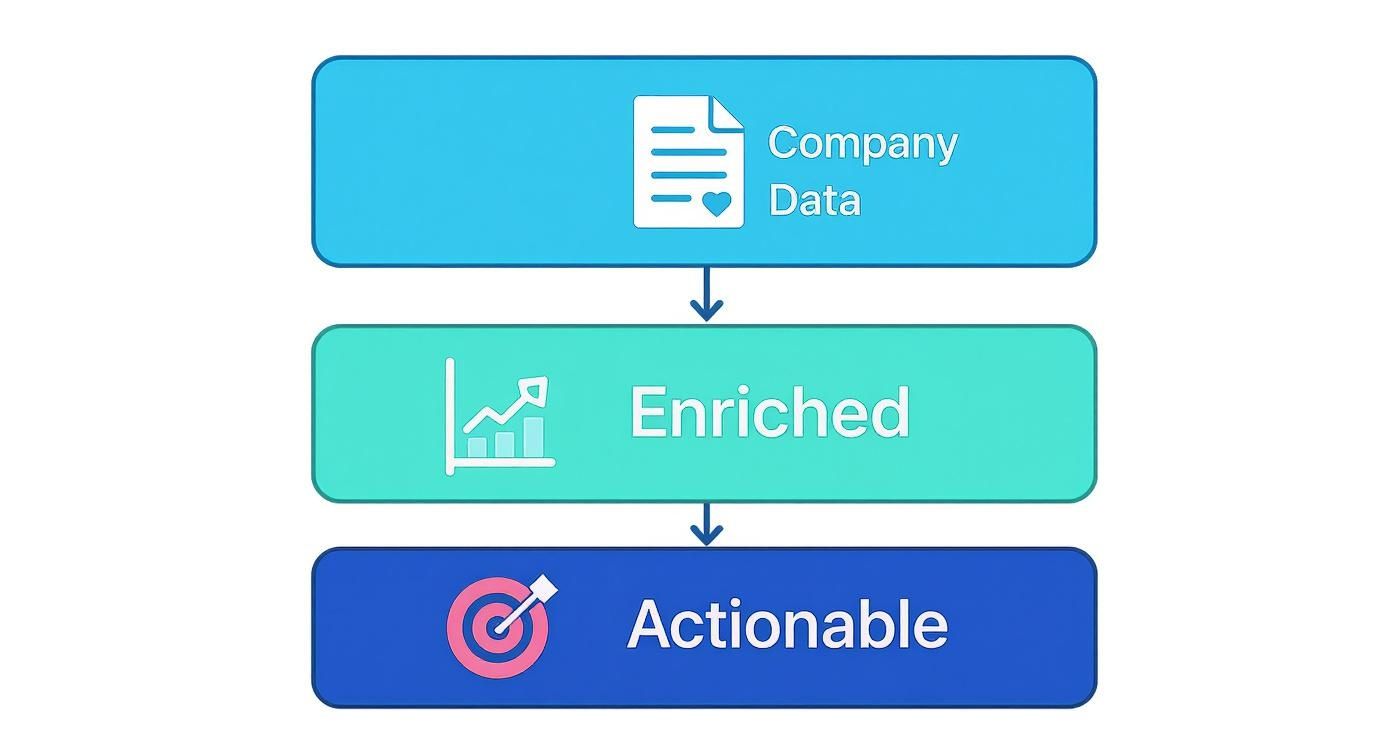
This simple flow shows how a basic piece of information evolves from an isolated fact into a genuine strategic asset, one that helps your teams make smarter, faster decisions.
Firmographic Data: The Company Blueprint
The absolute foundation of any B2B data profile is firmographic data. This is the company's official blueprint. It covers the essential, verifiable facts that rarely change and give you a stable, high-level overview of any business.
Firmographics answer the most fundamental questions you might have about an account:
- Industry: What market do they play in? (e.g., SaaS, Healthcare, Retail)
- Company Size: How many employees work there?
- Annual Revenue: What's their financial scale?
- Location: Where are their headquarters and other key offices?
This information is non-negotiable for basic segmentation. For instance, knowing a company is in the fintech space with over 500 employees immediately tells you whether they fit your ideal customer profile. To get a better sense of how industries are officially categorized, check out our guide on the NAICS Industry Classification API.
Technographic Data: The Digital Toolkit
While firmographics tell you about the business, technographic data reveals the tools it uses to operate. It’s like getting a peek inside a company’s digital toolkit, showing you everything from their CRM software to their cloud hosting provider.
Understanding a company’s tech stack gives you a massive advantage. If you sell a marketing tool that integrates perfectly with HubSpot, your sales team can instantly prioritize leads who already use it. Technographics answer questions like:
- What CRM are they running on?
- Which analytics tools are installed on their website?
- Are they using cloud services like AWS or Azure?
This context lets you tailor your pitch to their existing infrastructure, which makes your outreach feel far more relevant and compelling.
Intent Data: The Buying Signals
The most dynamic layer of enrichment is intent data. If firmographics are the blueprint and technographics are the tools, then intent data captures the company’s current activities and interests. It’s all about picking up on the digital signals that suggest a company is actively researching solutions like yours.
Intent data is the closest you can get to reading a prospect’s mind. It moves beyond who they are to reveal what they are interested in right now, turning cold outreach into a warm, timely conversation.
These signals can include things like:
- High-volume content consumption: Multiple employees from the same company are suddenly reading articles about a specific topic.
- Competitor website visits: They are actively checking out your competitors.
- Product review site activity: They are comparing features and pricing on sites like G2 or Capterra.
By picking up on these behavioral cues, your team can engage prospects at the perfect moment, right when they're in the buying cycle. This transforms your outreach from an unwelcome interruption into a helpful solution.
When you combine these three data types, you create a complete, 360-degree view, turning a simple lead into a rich, strategic opportunity.
How Enriched Data Drives Business Growth
Knowing the different types of data is one thing. Watching them work together to fuel actual business success? That's something else entirely. Company data enrichment isn't some abstract, back-end process, it's the engine that directly powers your bottom line, turning guesswork into precision and potential into profit.
Think of it this way: your business is a high-performance engine. Raw, unenriched data is like cheap, low-octane fuel. Sure, the engine might turn over, but it's going to sputter, struggle, and never hit its peak. Enriched data is the premium, high-octane stuff. It lets every part of the machine, sales, marketing, product, fire on all cylinders and accelerate forward.
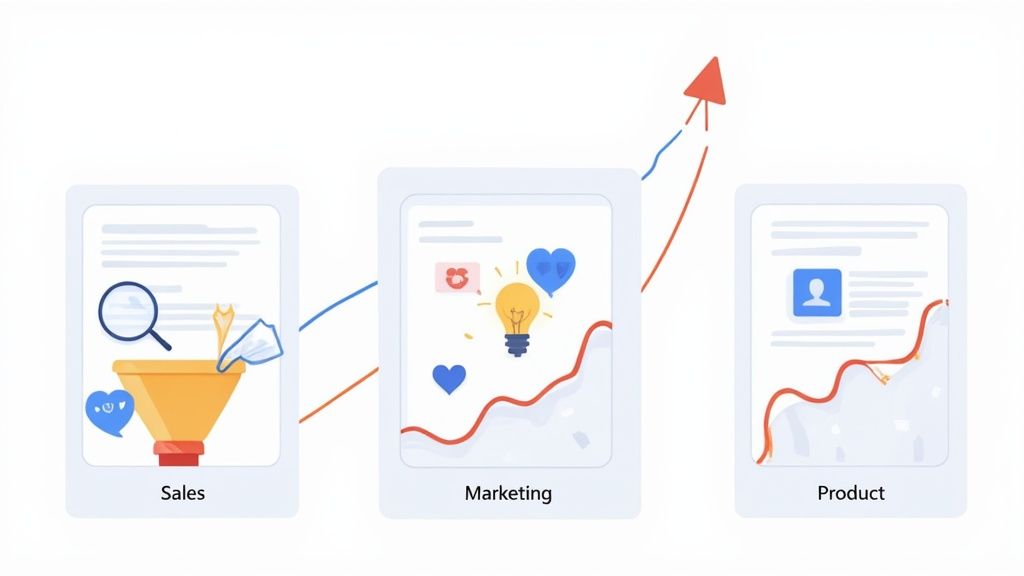
The impact here is real and measurable. Studies show that companies using lead enrichment see an average 25% increase in lead conversion rates and a 15% reduction in customer acquisition costs. Those aren't just vanity metrics; they represent a direct translation of better data into serious business wins. You can dig deeper into the impact of lead enrichment technologies to see the financial benefits for yourself.
Transforming Sales From Prospecting to Closing
For any sales team, time is money. Without enriched data, reps burn precious hours manually digging for clues about a lead, scouring LinkedIn for company size, guessing their industry, and trying to figure out who they even are. It’s slow, inefficient, and full of errors that lead to weak, poorly-timed outreach.
Now, picture a sales workflow supercharged by company data enrichment. A new lead comes in from a web form with just a name and an email. Instantly, the system bolts on critical context:
- Firmographics: They work at a 2,000-employee manufacturing company.
- Technographics: Their company already uses a competitor’s software.
- Intent Data: Someone from their IP just read three of your blog posts about a specific feature.
Suddenly, the salesperson can ditch the research and craft a pitch that actually lands. They know the company's probable pain points, they can speak to its scale, and they can reference a topic they know the prospect is interested in. The conversation immediately jumps from "So, what do you do?" to "I see you're looking for a better way to do X, and here's how we can help."
This shift completely changes the game, dramatically shortening the sales cycle. Reps stop chasing cold leads and start engaging with warm, well-understood prospects, focusing all their energy on accounts that are actually likely to close.
Crafting Hyper-Personalized Marketing Campaigns
Generic marketing gets ignored. It's that simple. In a world overflowing with emails and ads, the only way to cut through the noise is with genuine personalization. Company data enrichment is what gives marketers the raw material to build campaigns that feel like they were made for an audience of one.
Let's say a marketing team is launching a new feature for enterprise fintech companies. The old way? Blast a generic email to their entire database and hope for the best. The result is usually a dismal open rate, a spike in unsubscribes, and a massive missed opportunity.
With enriched data, the approach is more like a surgical strike. The team can instantly build a razor-sharp segment of contacts who fit the ideal profile:
- Work at a company in the fintech industry.
- The company has over 1,000 employees.
- Their job title is VP of Product or something similar.
Now, the campaign can speak directly to the specific challenges of a product leader at a large fintech firm. The messaging is sharp, the call-to-action is relevant, and the whole thing feels personally tailored. This doesn't just boost engagement, it builds real brand trust.
Guiding Product Development With Market Insights
Product teams often have to rely on a mix of user feedback and gut instinct to build their roadmaps. While that’s crucial, it can sometimes lead to building features for a vocal minority instead of the silent majority with the biggest market potential. Enriched data provides a powerful, data-backed reality check.
By analyzing enriched customer data in aggregate, product managers can spot trends and validate their hunches. They might, for example, discover that 30% of their new sign-ups are coming from the logistics industry, a vertical they weren't even targeting. That single insight could uncover a massive, untapped market.
This data-driven approach helps product teams prioritize features that solve real problems for high-growth segments. Instead of guessing what the market wants, they can build a roadmap based on hard evidence, ensuring their time and effort are aimed directly at genuine business opportunities.
Integrating Data Enrichment Into Your Workflow
Knowing why you need company data enrichment is one thing. Actually putting it to work is where the magic happens. The good news? You don't have to rip out your existing tech stack. Integration is all about plugging a powerful data source into the systems you already rely on, transforming what used to be a manual research chore into a slick, automated workflow.
The goal is simple: get enriched data exactly where your teams need it most. That could be your CRM, a marketing automation platform, or even a custom-built application. Let's break down the most common ways to bring this data to life with practical integration patterns you can use right away.
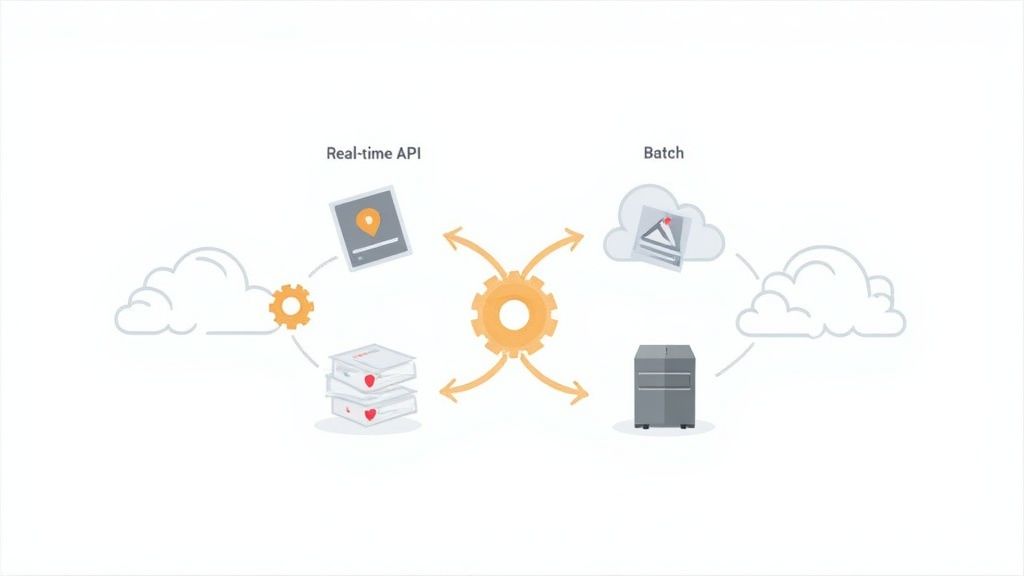 .
.
Batch Processing For Existing Data
Real-time is great for new leads, but what about the thousands (or millions) of records already collecting dust in your database? That's where batch processing shines. It’s a straightforward process: you upload a file (usually a CSV) of your existing contacts or accounts, and the enrichment service returns a new file with all the missing data filled in.
Think of batch processing as a deep clean for your entire database. It’s the most efficient way to refresh stale information and enhance every single record at once, ensuring your data is accurate and ready for your next big move.
This method is perfect for large-scale projects like:
- Database Cleansing: Refreshing your entire CRM to fix outdated info and fill in missing details across thousands of records.
- Large-Scale Segmentation: Adding firmographic or technographic data to a massive list to prepare for a major marketing campaign.
- Market Analysis: Enriching your whole customer base to get a bird's-eye view of its makeup, helping you spot trends and new opportunities.
A quick table can help you decide which approach, real-time API or batch file, makes the most sense for your immediate needs.
Choosing Your Data Enrichment Method
| Feature | Real-Time API Enrichment | Batch File Enrichment |
|---|---|---|
| Best For | On-demand, time-sensitive actions like lead routing and personalization. | Large, one-off database cleanup, segmentation, and analysis projects. |
| Speed | Instantaneous (milliseconds). | Slower (minutes to hours, depending on file size). |
| Trigger | Event-driven (e.g., a new user signs up). | Manual or scheduled (e.g., a quarterly database refresh). |
| Use Cases | Lead scoring, personalized onboarding, dynamic content. | Data cleansing, market analysis, campaign list preparation. |
| Data Flow | Continuous, record-by-record. | Bulk processing of a static file. |
| Tech Lift | Requires developer integration. | Minimal; often just a file upload. |
Ultimately, many companies end up using both. They use a batch process to clean up their historical data and then implement an API to keep all incoming data fresh and complete from day one.
Direct Platform Integrations
For many teams, the easiest path forward is a tool with pre-built connectors. Platforms like Salesforce, HubSpot, or Marketo often have native integrations that handle all the technical heavy lifting for you.
With these, you can set up powerful enrichment workflows without writing a single line of code. Just define your rules directly inside your CRM, for instance, "any time a new contact is created, automatically enrich it with company size and industry data." It’s the perfect blend of power and simplicity, making data enrichment accessible to everyone on the team.
Maintaining Trust Through Data Compliance
In the world of company data enrichment, getting more data is easy. Getting the right data, ethically sourced and legally compliant, is what actually builds a business. As you assemble richer customer profiles, you're also taking on the critical responsibility of protecting their privacy. Trust, once lost, is nearly impossible to get back.
This isn't just about dodging fines; it’s about basic respect for your customers. Regulations like the General Data Protection Regulation (GDPR) in Europe and the California Consumer Privacy Act (CCPA) have set firm ground rules for how personal data is collected, used, and stored. Violating them brings massive penalties, but the real cost is the permanent damage to your brand.
Navigating Key Privacy Regulations
You don't need to be a lawyer, but understanding the spirit of these laws is the first step toward responsible enrichment. While each regulation has its own flavor, they all circle back to a few core ideas.
- Purpose Limitation: You must have a specific, legitimate reason for enriching data. The old habit of hoarding information "just in case" is over.
- Data Minimization: Only enrich the data points you actually need for that specific purpose. Avoid grabbing excessive personal details just because you can.
- Transparency and Consent: Be upfront about what data you're collecting and why. For many use cases, you'll need explicit permission before you process someone's data.
These principles are the bedrock of a trustworthy data strategy. They force a shift in thinking from what you can do with data to what you should do.
Best Practices for Compliant Enrichment
Staying compliant is a proactive sport, not a reactive one. It means building governance directly into your data enrichment workflows from day one. This discipline ensures your teams handle customer information responsibly at every single touchpoint.
Strong compliance isn't a barrier to a successful data strategy, it's a core component. By prioritizing ethical data handling, you build customer trust that translates directly into long-term loyalty and business growth.
To put this into practice, focus on these concrete steps:
- Vet Your Data Providers: Not all data sources are created equal. Only partner with enrichment providers who are transparent about where their data comes from and can prove their own compliance with laws like GDPR.
- Maintain Strict Data Hygiene: Regularly clean your database to keep it accurate. That means removing outdated contacts and, critically, honoring all opt-out requests immediately.
- Document Everything: Keep a clear trail of where your data comes from, how you got it, and when you received consent. This audit trail is your best friend when it comes to accountability.
This focus on compliance is a major force shaping the industry. In fact, the data enrichment market's continued growth is partly driven by stricter regulations demanding clean, current, and contextually relevant data. You can discover more about the data enrichment market trends to see how compliance is pushing innovation. By embedding these practices, you ensure your enrichment efforts are both powerful and principled.
Measuring the ROI of Data Enrichment
Pouring money into company data enrichment isn't just a technical expense; it's a strategic business move. And like any other investment, you have to prove it's paying off. How do you go from a vague feeling that your data is better to actually demonstrating its financial impact?
The secret is to draw a straight line from enrichment to the key performance indicators (KPIs) that really matter to the business. It’s not about wrestling with complicated formulas. It’s about tracking the right metrics to build a rock-solid business case that justifies the cost and cements the value of high-quality data.
Key Metrics That Reveal True Value
To really nail down your ROI, you need to zoom in on the metrics that are most directly impacted by a deeper understanding of your customers. These KPIs will give you a clear "before and after" picture of your enrichment efforts.
Start by tracking these core indicators:
- Lead Conversion Rate: With enriched data, your sales team isn't flying blind. They can zero in on high-fit leads and personalize their outreach, which should directly boost the percentage of leads that become paying customers.
- Customer Lifetime Value (CLV): Better data means you can deliver better, more personalized experiences. That keeps customers happy and loyal, driving up retention. A rising CLV is a fantastic sign you're not just winning customers, but keeping the right ones.
- Sales Cycle Length: When reps get fully enriched leads, they slash the time they'd normally spend on manual research. They get to spend more time actually selling, which naturally shortens the journey from first contact to a closed deal.
Proving the value of data enrichment means translating data quality improvements into dollars and cents. A shorter sales cycle, higher conversion rate, and lower acquisition cost are the language that every stakeholder understands.
Connecting Metrics to Business Impact
These KPIs don't live on an island; they all influence each other to paint a complete financial picture. For example, a shorter sales cycle directly lowers your Customer Acquisition Cost (CAC) because your team can close more deals using the same resources.
If you need a refresher on the nuts and bolts, check out this detailed guide for calculating your cost of customer acquisition.
Plus, by using enrichment to disqualify bad leads sooner, you stop wasting marketing dollars on people who were never going to buy anyway. It’s a win-win for efficiency.
Building Your Business Case for Enrichment
Once you're armed with these metrics, you can build a powerful argument for investing in (or expanding) your data enrichment strategy. A simple, four-step framework is all you need to get stakeholders on board.
- Establish a Baseline: Before you flip the switch on an enrichment tool, get a clear snapshot of your current performance. Track the KPIs mentioned above for at least one full quarter to know where you're starting from.
- Implement and Track: Once your enrichment solution is live, keep a close eye on those same metrics. Watch how they trend over the following weeks and months.
- Calculate the Financial Lift: Now it’s time to put a dollar value on the improvements. For instance, a 10% increase in your conversion rate on 1,000 leads, with an average deal size of $5,000, translates directly to $50,000 in fresh revenue.
- Compare Costs to Gains: Finally, stack up the financial gains against what you're paying for the enrichment platform. When you can show a clear, positive return, the decision to invest becomes a no-brainer.
This data-driven approach shifts the conversation entirely. Data enrichment is no longer a discretionary "nice-to-have" but a proven revenue-driver, earning its place as a cornerstone of your growth engine.
Got Questions About Data Enrichment?
As teams start digging into company data enrichment, a few practical questions almost always pop up. Getting these basics straight from the beginning helps build a data strategy that actually works. Let's tackle some of the most common ones.
Data Enrichment vs. Data Cleansing
Lots of people use these terms interchangeably, but they’re two different sides of the same coin. Think of your database like a library.
Data cleansing is like tidying up the shelves you already have. It's about fixing typos, merging duplicate records, and getting rid of outdated info, like correcting a misspelled company name or removing a contact who's left their job. It makes sure the data you have is accurate.
Company data enrichment, on the other hand, is about adding brand-new books to those shelves. It takes a single piece of information you know (like a company's domain) and brings back a ton of valuable context you didn't have, like their industry, employee count, or the tech they use. Cleansing fixes what's there; enrichment adds what's missing.
How Often Should We Enrich Our Database?
This really depends on how you use your data, but a "one-and-done" approach is a recipe for stale information. B2B data decays surprisingly fast. People change jobs, companies get acquired, and tech stacks are always in flux.
To keep your database truly actionable, you need a mix of real-time and periodic enrichment. A good rule of thumb is to run a full batch enrichment on your entire database at least once a quarter. This helps you catch any systemic changes and keep everything fresh.
But for high-stakes moments like routing a new inbound lead or personalizing a welcome email, real-time enrichment is a must. This makes sure every new record is complete and accurate the second it hits your system, so you can act on it immediately.
Starting Data Enrichment On a Budget
You don't need a massive budget to get going. The key for smaller businesses is to take a lean approach and focus on high-impact data points first. Instead of trying to enrich every possible field for every record, pinpoint the three to five fields that would make the biggest difference to your sales or marketing efforts right now.
Maybe that's just industry, company size, and location. By starting with a narrow focus, you can use more affordable, pay-as-you-go API services. This lets you prove the ROI on a small scale before you decide to invest more heavily.
Key Signs You Need a Data Enrichment Solution
So, how do you know when it’s time to pull the trigger? Look for these common pain points in your daily operations:
- Your lead scoring is basically a guessing game because you’re missing key firmographic data.
- Your sales reps are losing hours every week manually digging through LinkedIn to research prospects.
- Marketing campaigns are falling flat because the messaging is too generic to resonate.
- Your CRM is a graveyard of incomplete records, making it impossible to segment your audience properly.
If any of these sound painfully familiar, it’s a clear sign your teams are flying blind.
Ready to turn your raw data into a strategic asset? With Brand.dev, you can instantly enrich any company record with logos, firmographics, tech stacks, and more through a simple API. Start building for free today.