
Customer data enrichment is the process of taking the raw, basic information you have about a customer and fleshing it out with details from other sources. It turns an incomplete contact record into a complete, actionable profile, giving you a much clearer picture of who your customers really are.
Turning Raw Data Into Your Biggest Asset
Think of your current customer database as a collection of blurry, out-of-focus photos. You can make out the basic shapes, a name here, an email address there, but all the critical details that bring the person to life are missing. Customer data enrichment is how you bring that picture into sharp focus.
It’s a simple but powerful idea: take the first-party data you already own and merge it with reliable, third-party information to build a comprehensive customer view. It’s no longer about just having data; it’s about having the right data. Incomplete records become a powerful engine for smarter marketing, targeted sales, and exceptional customer service.
Why Complete Customer Profiles Matter
A complete customer profile is the foundation for any meaningful engagement. Without it, you’re just guessing. With it, every interaction can be precise and relevant.
The impact is huge, and it's driving a market that’s expanding fast. The global data enrichment solutions market was valued between $2.1 billion and $2.4 billion in 2023–2024, and it's expected to hit $6.3 billion by the early 2030s. This growth isn't just hype; it shows a real, pressing need for complete customer data to power modern personalization. You can dig into the numbers in the full research on data enrichment solutions.
By transforming a simple contact list into a rich dataset, you unlock the ability to understand customer needs before they even express them, paving the way for proactive and personalized experiences.
From Basic Contact To Actionable Insight
So, what does this transformation actually look like?
Let’s say a new user signs up for your product with just an email address. Initially, you know almost nothing about them. But after enrichment, that single piece of information blossoms into a detailed, usable profile.
To see just how dramatic the change is, here’s a quick before-and-after look at a typical customer record.
Before And After Customer Data Enrichment
| Data Point | Before Enrichment (Initial Data) | After Enrichment (Enriched Data) |
|---|---|---|
| Name | Jane Doe | Jane Doe |
| jane.doe@acme.com | jane.doe@acme.com | |
| Company | (Unknown) | Acme Corporation |
| Job Title | (Unknown) | VP of Marketing |
| Industry | (Unknown) | B2B SaaS |
| Company Size | (Unknown) | 501-1,000 Employees |
| Location | (Unknown) | San Francisco, CA |
| Socials | (Unknown) | LinkedIn Profile |
| Tech Stack | (Unknown) | Salesforce, HubSpot, AWS |
As you can see, the "after" column isn't just more data, it's a story. You've gone from a simple email address to a person with a role, working at a specific company, in a particular industry.
This is the core value of customer data enrichment. It’s the shift from a basic contact to an actionable insight, and it sets the stage for every successful interaction that follows.
Building a 360-Degree Customer View
To really understand a customer, you need to go beyond a name and an email address. You have to add layers of information that reveal who they are and what they’re trying to accomplish. It’s like a novelist creating a character profile; you start with the basics, then add details about their background, profession, and habits to make them feel real.
Each new piece of data adds depth and context, turning a flat contact record into a multi-dimensional story. This isn't just about collecting random facts, either. It’s a strategic process. You’re adding specific attributes that unlock real business actions, like knowing a company’s industry to sharpen your marketing or understanding their tech stack so your sales team can frame your product as the perfect fit.
The Essential Data Layers
The most valuable enrichment data usually falls into a few key categories. Think of each one as a different lens for viewing your customer. When you put them all together, you get that powerful, 360-degree perspective.
-
Firmographics: This is the foundational stuff about a company, their size, industry (often using official codes like NAICS), annual revenue, and where they're located. Firmographics help you answer the first big question: "Is this company even a good fit for us?"
-
Technographics: This layer peels back the curtain on the technology a company uses. Knowing their CRM, marketing automation platform, or cloud provider gives you incredible insight into their operational maturity and where you might integrate.
-
Behavioral Data: This is all about how a customer interacts with your business. It includes their purchase history, website activity, feature usage, and support tickets. Behavioral data tells you what a customer is interested in right now.
The push to gather and act on these data layers is huge. The U.S. data enrichment market was pegged at around USD 0.60 billion in 2023 and is on track to blow past USD 1.58 billion by 2033. Big companies are leading the charge, needing deep enrichment for everything from personalization to risk assessment. You can dig into the numbers in this detailed report on the data enrichment solutions market.
From Data Points to Business Decisions
Combining these data types is where the magic really happens. Imagine a new lead signs up, a "Director of Engineering" at a 200-person tech company (firmographics).
You enrich their profile and find out their company uses Stripe for payments and Intercom for support (technographics). At the same time, your own internal analytics show they’ve been all over your API documentation page (behavioral data).
Suddenly, you have a crystal-clear picture: this is a technically-savvy lead from an ideal-fit company who is actively evaluating a solution just like yours.
This single, enriched view shifts your team from being reactive to proactive. Instead of a generic "checking in" email, your sales team can craft a hyper-relevant message. They can talk directly about potential integration points with Stripe and Intercom and even reference the exact API docs the lead was looking at. This is how customer data enrichment turns raw information into closed deals.
How Data Enrichment Works Behind The Scenes
Customer data enrichment can feel a bit like magic, but it's actually a pretty logical process with clear steps. It all boils down to taking one small piece of information you already have, like a customer's email address, and using it as a key to unlock a trove of useful data from a trusted third-party provider. The whole point is to pipe that new, richer information back into your systems without any friction.
This happens in one of two ways, and the right choice really depends on when you need the data and what you’re planning to do with it.
Real-Time vs. Batch Enrichment
The first approach is real-time enrichment, sometimes called API enrichment. Think of it as an instant background check. The moment a new user signs up on your website, your system pings an enrichment provider with their email. Within milliseconds, the provider’s API finds a match in its database and sends back a full profile: company name, job title, industry, you name it. This is perfect for personalizing a user's onboarding experience from the second they join.
The second method is batch enrichment. This is more like taking a census of your entire database. You upload a big list of your existing contacts (usually a CSV file), and the provider processes the whole file at once, filling in the blanks for every record it can find. Once it's done, you get a completed file back. This is the way to go when you need to clean up an older database or get ready for a big, segmented marketing campaign.
The diagram below shows how different data types come together to build that complete customer profile, which is really the end goal of any enrichment effort.
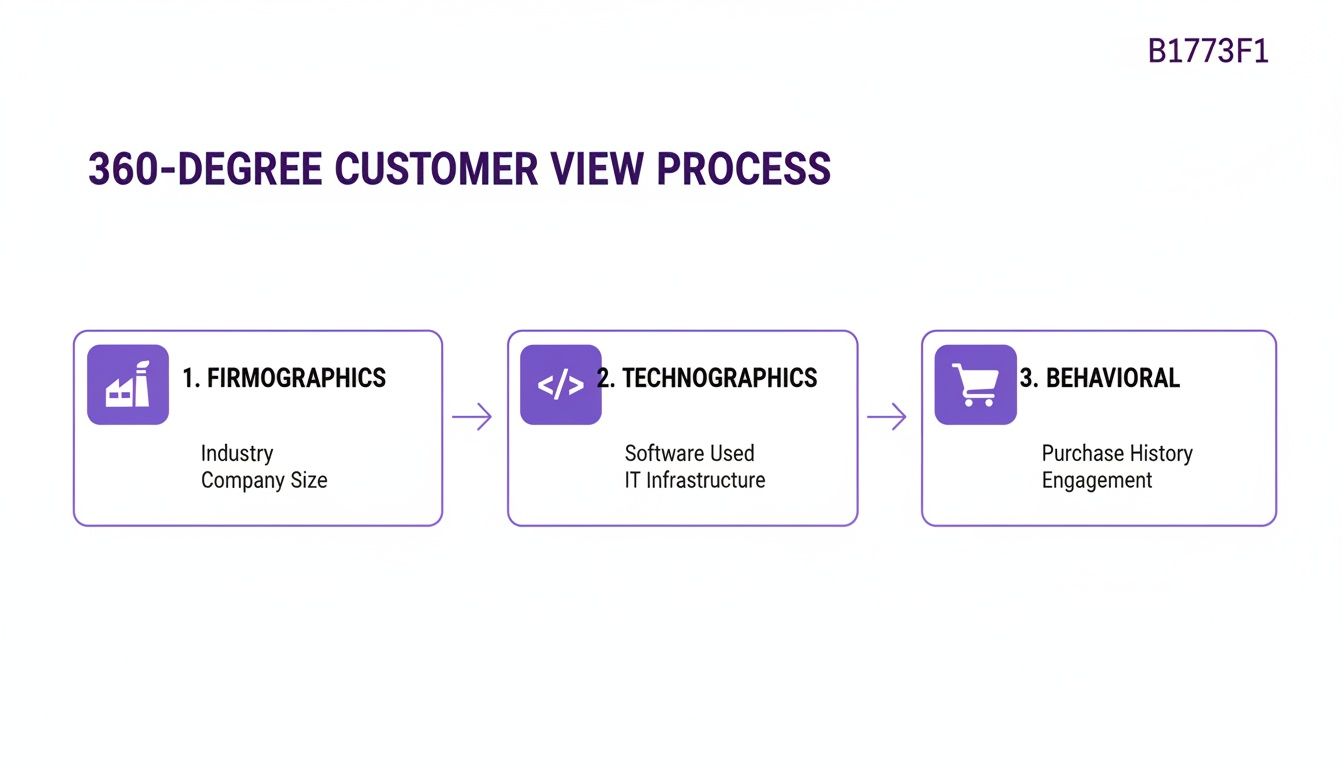
This flow really drives home how firmographics, technographics, and behavioral insights layer on top of each other to create a rich, multi-dimensional understanding of your customer.
Keeping Your Data Clean and Accurate
Just dumping new data into your CRM isn't enough; you have to make sure it's high-quality and doesn't just create a bigger mess. This means handling a few critical housekeeping steps.
Data Mapping: This is where you tell your system exactly where each new piece of data should go. It's like creating a seating chart for your information, making sure the "company size" data from the provider lands squarely in the "company_size" field in your CRM, not somewhere else.
If you don't map your data correctly, you'll end up with chaos. But mapping is just one piece of the puzzle. Two other processes are vital for keeping your database healthy:
- Data Validation: This step confirms that the information being added is actually correct and properly formatted. To ensure the accuracy and reliability of your contact database, a robust process of email address verification is essential to your enrichment efforts.
- Deduplication: This process scans for and merges duplicate records. It’s what stops you from having three slightly different, incomplete profiles for the same person, giving you a single source of truth for each customer.
These technical steps all work together to make customer data enrichment a reliable and powerful tool. If you're focused specifically on enriching company data, our guide to B2B data enrichment offers more targeted strategies.
Putting Your Enriched Data Into Action
This whole process is about turning raw data into real-world results. Once you've cleaned up and enriched your customer profiles, it's time to put that data to work.
This is where the rubber meets the road, moving from clean data in a database to tangible impacts on your revenue, efficiency, and customer happiness. The real win comes from embedding this richer data directly into the day-to-day tools your teams already use, turning insights into immediate action.
Supercharge Your Sales and Lead Scoring
For any sales team, timing and context are gold. Enriched data gives them both, acting as a smart filter to separate high-value leads from the noise. Instead of throwing every new signup into the same bucket, your team can instantly spot prospects who fit your ideal customer profile (ICP).
Think about it: a new lead signs up with just an email address. Without enrichment, it’s a shot in the dark. With it, you can instantly pull back key firmographics:
- Company Size: Is this a two-person startup or a 5,000-employee enterprise?
- Industry: Are they in a core vertical you absolutely crush it in?
- Annual Revenue: Can they actually afford your top-tier plan?
This isn't just nice-to-have information; it's the backbone of a sophisticated, automated lead scoring system. A lead from a 500-person SaaS company might instantly get a score of 95 and be routed to a senior AE, while a student signup gets a 10 and is dropped into a nurturing sequence. This kind of precision ensures your sales team spends their time on deals that have a real chance of closing. For a deeper dive, our guide on CRM data enrichment has more strategies for wiring these insights right into your sales pipeline.
Create Hyper-Personalized Marketing Campaigns
Generic, one-size-fits-all marketing is dead. With enriched data, your marketing team can slice and dice audiences with surgical precision, creating experiences that feel like they were made for one person. And we’re talking about a lot more than just [First Name] merge tags.
By understanding a customer's industry, role, and even the tech they use, you can tailor every single touchpoint. Your email copy, ad creative, and website content can speak directly to their world, their problems, and their goals.
Imagine your website dynamically changing its headline based on who's visiting. A prospect from a fintech company sees, "Secure Financial Data for Modern Banking," while someone from e-commerce sees, "Boost Your Online Sales by 30%." That level of relevance makes people feel understood, which is a massive driver for conversions.
Streamline Operations and Enhance AI
The ripple effects of good data run deep. For finance teams, having verified company names and addresses means automated invoicing and fewer billing errors. It's a simple fix that saves hours of mind-numbing manual work and helps keep cash flow healthy.
But the real game-changer is how enriched data fuels AI. If you're training an LLM to write sales emails, feeding it rich profiles gives it the context needed to draft something genuinely compelling. Instead of spitting out a generic template, the AI can reference the prospect’s industry-specific pain points or mention a recent company milestone.
This fusion of AI and real-time data is where massive growth is happening. Companies using modern AI-driven enrichment are seeing up to 40% higher revenue. It’s no surprise the market for this tech is on track to hit $1.4 billion by 2025. You can get more color on this trend by reading these insights on real-time customer data.
Your Practical Data Enrichment Checklist
Alright, let's move from theory to action. Kicking off a data enrichment program isn't a flip-of-a-switch task. It’s a structured process that starts with a hard look at what you already have and a clear vision for what you need. This checklist will give you a practical roadmap to get started.
First things first: run an internal audit. You can't fill the gaps if you don't know where they are. Dive into your CRM or database and analyze your current customer data. Are you constantly missing job titles for new leads? Is company size or industry data a black hole? Pinpointing these specific weak points is the critical first step.
Once you know what’s missing, you can set real, measurable goals. A fuzzy objective like "improve our data" is useless because you'll never know if you've succeeded. Instead, you need to aim for specific outcomes.
A strong goal sounds like this: "We will enrich all new leads with firmographic data to improve our lead qualification accuracy by 20% within the next quarter." This creates a clear benchmark for success and holds everyone accountable.
Finding The Right Partner
With your goals locked in, the next phase is picking a data provider. This is a huge decision. The quality of their data will directly make or break your results. As you start building out your plan, it's worth exploring the best data enrichment tools to see what's out there.
When you're vetting potential vendors, zero in on a few key areas:
- Data Accuracy and Freshness: Ask them how often their data is updated. Stale information is often worse than no information at all. Don't be afraid to ask for accuracy guarantees or to run a small sample of your own data through their system as a test.
- Coverage: Does their database have solid coverage for your specific industry or geographical region? Make sure their data aligns with your target market, otherwise you're paying for data you can't even use.
- Integration and API Quality: How easily can you plug their service into your existing stack, like your CRM or marketing automation platform? Take a good look at their developer documentation, if it's a mess, that's a major red flag.
To help with this process, here's a checklist you can use to compare different vendors side-by-side.
Data Enrichment Vendor Evaluation Checklist
Use this table to objectively score potential partners and ensure you're choosing a provider that aligns with your technical, business, and compliance needs.
| Evaluation Criterion | Description | Importance (High/Medium/Low) |
|---|---|---|
| Data Accuracy | What is the vendor's claimed accuracy rate? Do they offer an SLA or guarantee? | High |
| Data Freshness | How frequently is the data updated (e.g., daily, quarterly)? | High |
| Data Coverage | Does the provider have sufficient data for your target industries and regions? | High |
| Attribute Depth | Does the vendor offer the specific data points you need (e.g., NAICS codes, tech stack)? | High |
| API Quality | Is the API well-documented, reliable, and easy to integrate with? Check response times. | High |
| Integration Support | Do they offer pre-built connectors for your key systems (CRM, MAP)? | Medium |
| Compliance | Is the vendor compliant with relevant regulations like GDPR and CCPA? | High |
| Scalability & Pricing | Does the pricing model scale fairly with your usage? Are there hidden fees? | Medium |
| Support | What level of technical support is offered (e.g., email, dedicated account manager)? | Medium |
| Sample Data Test | Did the vendor perform well when you tested a sample of your own data? | High |
Choosing a vendor isn't just about the data; it's about finding a partner whose technology and support model fits your long-term strategy.
Planning Your Implementation
Finally, it's time to map out the technical and compliance details. Sketch out the integration workflow. Will you use real-time API calls for every new signup, or will you run batch jobs to enrich existing records? Define the data mapping carefully to ensure every new attribute lands in the right field in your systems.
And don't forget privacy. From day one, make sure your chosen provider adheres to regulations like GDPR and CCPA, and confirm that your own data handling processes are transparent and respect user consent. Tackling this proactively ensures your entire enrichment initiative is built on a solid, compliant foundation.
Measuring Success And Navigating Challenges
Launching a customer data enrichment strategy is a fantastic first step, but the real work begins after the integration is live. To make sure the investment pays off and continues to deliver, you have to measure its impact and know how to handle the inevitable bumps in the road.
Success isn't about hoarding data points. It's about what you do with them. The key performance indicators (KPIs) you track should draw a straight line from your enrichment efforts to tangible business results. Forget simply counting how many records you've enriched, focus on the metrics that actually move the needle.
Defining Your Key Performance Indicators
Think in terms of real-world improvements. Are your sales and marketing funnels getting smoother and more effective? Are customers sticking around longer?
Here are a few metrics worth keeping a close eye on:
- Higher Lead-to-Opportunity Conversion Rate: When sales teams have richer data, they can qualify leads faster and with more confidence. This means more high-quality prospects actually move down the pipeline instead of getting stuck.
- Increased Customer Lifetime Value (CLV): Better, more personal experiences, powered by rich data, build stronger relationships. That translates directly to less churn and customers who spend more over the long haul.
- Improved Campaign Engagement: Marketing campaigns built on precise firmographic or behavioral data just perform better. You’ll see it in your open rates, click-throughs, and, most importantly, conversions.
Tracking these KPIs gives you the hard evidence you need to prove the return on your investment.
Overcoming Common Hurdles
Even with the best tools in place, you’re going to hit a few snags. The trick is to see them coming so you can keep your momentum and ensure your data stays trustworthy.
One of the most frequent issues is data discrepancy, where different sources give you conflicting information. Maybe your CRM says a company is based in one city, but your enrichment provider says another. You need a clear protocol for who wins.
Decide which data source is the ultimate authority for specific fields, or set up a quick manual review process for any conflicts. This simple step prevents data chaos and keeps everyone trusting the system.
You might also run into integration hiccups or discover costs creeping up. Make a habit of regularly checking your API performance and usage logs to catch problems early. A huge part of this is picking the right partner from day one. Our comparison of leading data enrichment companies can help you find a provider whose reliability and pricing fit your needs, minimizing surprises later on.
By actively managing these challenges, you can make sure the impact of your customer data enrichment efforts is built to last.
Frequently Asked Questions
Got questions? You're not the only one. Here are a few of the most common things people ask about customer data enrichment.
What Is The Difference Between Data Enrichment And Data Appending?
It's easy to get these two mixed up, but think of it this way: appending is just one piece of the puzzle, while enrichment is the whole picture.
Data appending is the act of adding a specific, missing piece of information. For example, you have a customer's email but no phone number, so you append the phone number to their record. It's a simple addition.
Customer data enrichment, on the other hand, is a much broader process. It definitely includes appending missing details, but it also involves cleaning, verifying, and updating the information you already have. The goal is to make the entire customer profile more accurate, complete, and reliable.
How Do I Ensure The Enriched Data Is Compliant?
This is non-negotiable, and it all boils down to trust and transparency. First, you absolutely must partner with a reputable data provider, one that is completely open about its data sources and strictly follows regulations like GDPR and CCPA. Your contract should always include a data processing agreement (DPA) to keep everything above board.
On your end, your internal processes have to respect user consent. This means providing clear opt-out options and only using enriched data for legitimate business purposes you’ve already told your customers about.
The core principle here is transparency. Your data practices need to be ethical, clearly communicated to users, and backed by a provider who cares about privacy as much as you do.
Can I Perform Data Enrichment In-House?
Technically, yes, but it's a massive undertaking. Building a system from scratch means dedicating serious engineering resources to develop and maintain web scrapers, find and integrate public datasets, and build complex algorithms to match everything up. It's a full-time job for a team of specialists.
For most businesses, trying to DIY this just isn't practical or cost-effective. Third-party services bring specialized expertise, huge data networks, and ready-to-use APIs to the table. It’s almost always the more reliable and scalable path to getting high-quality results without derailing your product roadmap.
Ready to bring your customer profiles to life? With Brand.dev, you can instantly enrich any record with logos, colors, industry codes, and more using a simple API. Start personalizing for free.