
B2B demand generation is all about playing the long game. It's the art of creating awareness and genuine interest in what you do, building a relationship with future customers long before they even think about buying. The goal is to make your brand the first, and only, one they think of when a need finally arises.
What Is B2B Demand Generation Anyway?
Let's ditch the formal definitions for a minute. Think of B2B demand generation as the engine that powers your entire growth machine. It’s not just one tactic; it's the whole process of making your target market truly want your solution.
Imagine you’re trying to grow a garden. You wouldn't just toss seeds onto dry, cracked earth and hope for the best. You’d spend time cultivating the soil, adding nutrients, and making sure it has the right amount of water and sun. You create the perfect environment for growth.
That groundwork is exactly what B2B demand generation does for your business. It prepares the market by educating prospects, building trust, and positioning your brand as a helpful authority. Only when that soil is rich and ready can you start planting seeds, which is where lead generation comes in.
Demand Generation vs. Lead Generation
This is where a lot of marketers get tripped up. People often use "demand gen" and "lead gen" interchangeably, but they are two very different beasts with distinct jobs. Getting this right is fundamental to building a marketing function that actually drives revenue.
Demand generation makes your audience aware they have a problem and that solutions like yours exist. Lead generation is the next step: capturing the details of those who are actively looking for a solution. One creates the market; the other harvests it.
The lines are blurring, though. Smart marketers now see that you can't have great demand gen without strong brand awareness. A trusted brand makes demand generation easier, and effective demand generation turns that trust into a real sales pipeline. For more on this, you can dig into the latest demand generation statistics on pipeline-360.com.
To make it crystal clear, let's break down the key differences in a table.
Demand Generation vs. Lead Generation At a Glance
The table below highlights the core differences in goals, tactics, and how you measure success for each strategy.
| Attribute | Demand Generation | Lead Generation |
|---|---|---|
| Primary Goal | Educate the market, build brand authority, create desire. | Capture contact information from interested prospects. |
| Target Audience | Your entire addressable market (broad). | A qualified subset of your market (narrow). |
| Core Tactics | Ungated content: blog posts, podcasts, social media, videos. | Gated content: webinars, eBooks, demos, free trials. |
| Key Metrics | Website traffic, content engagement, brand search volume. | MQLs, SQLs, Cost per Lead (CPL), conversion rates. |
| Funnel Stage | Top-of-Funnel (Awareness, Interest). | Mid-to-Bottom-of-Funnel (Consideration, Decision). |
| Mindset | "How can I help my audience solve their problem?" | "How can I get this person's email address?" |
Ultimately, great lead generation is impossible without demand generation paving the way. A prospect who already knows you, trusts your expertise, and respects your brand is infinitely more valuable than a cold name captured from a form. B2B demand generation is how you build a steady, predictable stream of those ideal, well-informed prospects.
Choosing Your B2B Strategic Framework
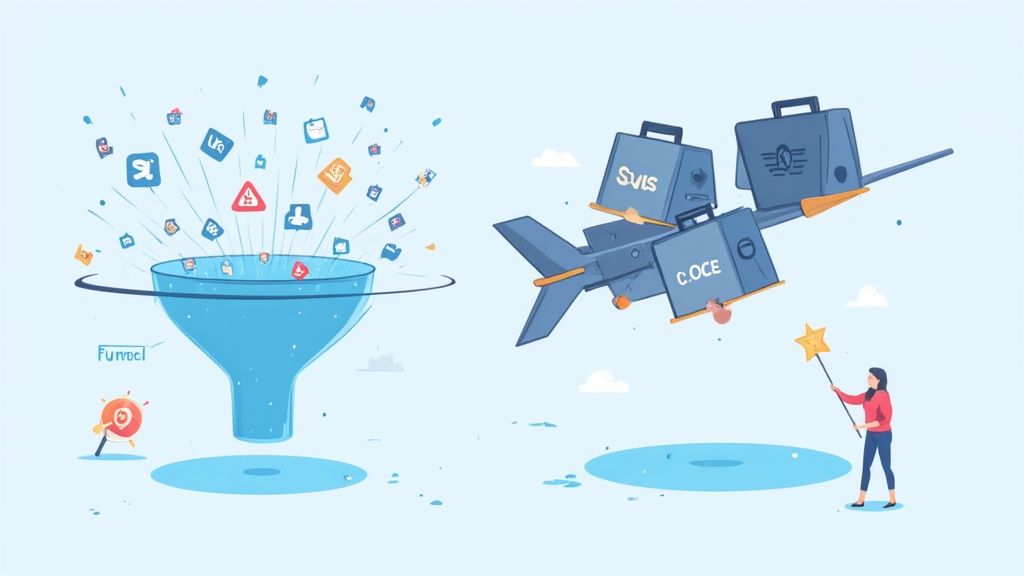
Every great B2B demand gen program needs a blueprint. Without one, your tactics are just disconnected activities, like trying to build a house without architectural plans. Two models really dominate modern demand generation: the classic wide-net funnel and the precision strike of Account-Based Marketing (ABM).
Getting a handle on these approaches is a must. They shape everything from the content you create to how you work with your sales team. The framework you pick determines who you talk to, what you say, and how you'll ultimately measure success.
The Traditional Funnel Approach
Think of the traditional demand generation funnel as casting a wide net into the ocean. The idea is to catch as many potential fish (your prospects) as you can by appealing to a pretty broad slice of your target market. You pull in a large audience at the top with great content, then slowly nurture them through the stages of awareness and consideration.
This model is all about volume and probability. By engaging thousands of potential buyers with blog posts, webinars, and social media, you filter them down into a much smaller, more qualified group that’s actually ready to talk to sales.
- Best For: Companies with a large addressable market, a relatively short sales cycle, and a lower average contract value (ACV).
- Key Focus: Raking in a high volume of individual leads and tweaking conversion rates at every single stage of the funnel.
The funnel-led strategy is a beast at building broad brand awareness and creating a consistent, predictable flow of inbound interest.
The Account-Based Marketing Approach
In total contrast, Account-Based Marketing (ABM) is like spear fishing. Forget the wide net. Here, you hand-pick a specific list of high-value target accounts. You’ve already decided they're a perfect fit, so the goal completely shifts from lead quantity to deep, account-level engagement.
This approach flips the traditional funnel on its head. Marketing and sales teams have to work in lockstep to create deeply personalized campaigns for each target account, essentially treating each one as a market of its own. If your average contract value is over $10,000, an ABM strategy can deliver some serious ROI by focusing your resources where they'll have the biggest impact.
ABM isn't about finding more leads; it's about getting into the right accounts. It aligns marketing and sales resources to engage a select group of target companies with personalized experiences designed to drive specific business outcomes.
To pull off ABM, you absolutely must have an ironclad understanding of who you're targeting. For a deep dive into this foundational step, check out our guide on how to create an ideal customer profile template.
Deciding Which Framework Is Right For You
Picking between a funnel-led strategy and ABM isn't just a marketing decision, it's a business decision. It all comes down to your goals, your market, and how your sales process is structured.
| Factor | Funnel-Led Generation | Account-Based Marketing (ABM) |
|---|---|---|
| Targeting | Broad; focuses on personas and industries. | Narrow; focuses on a curated list of best-fit accounts. |
| Sales Cycle | Shorter, often less complex. | Longer, involving multiple decision-makers. |
| Metrics | Lead volume, MQLs, conversion rates. | Account engagement, pipeline velocity, deal size. |
| Collaboration | Sequential handoff from marketing to sales. | Deep, continuous alignment between marketing and sales. |
For many companies, the answer isn't "either/or" but "both." A hybrid model often hits that perfect sweet spot. You can use a broad funnel approach to build general brand awareness and capture inbound interest, all while running targeted ABM campaigns for your most strategic, high-value accounts.
This lets you scale efficiently while still hunting for the biggest deals, giving you the best of both worlds in your B2B demand generation efforts.
Essential Channels and Tactics for Generating Demand
With a solid strategy in place, it’s time to get your hands dirty. The right channels and tactics are what breathe life into a B2B demand generation program, turning your high-level goals into actual conversations and real interest from your audience.
Great demand generation always starts with giving, not taking. Forget the old "give me your email for this PDF" mentality. The foundation is creating genuinely helpful, non-gated content that builds a library of resources and establishes you as the go-to authority in your space.
Think of this content as the bedrock of your brand's reputation, the insightful blog posts, original research, and killer podcasts people actively seek out and share because they solve a real problem.
Building Your Content and SEO Foundation
Content marketing and Search Engine Optimization (SEO) are the inseparable duo that drives organic demand. You can create the most brilliant content in the world, but if your ideal customers can't find it, it might as well not exist. SEO is the engine that gets your hard work discovered right when someone is looking for a solution.
The goal is simple: answer the questions your prospects are asking long before they’ve ever heard of your company. By creating content that’s optimized for the right keywords, you position your brand as the helpful expert at the exact moment of need.
Creating demand isn't about shouting the loudest; it's about being the most helpful and consistently showing up where your audience is already looking for answers. This builds trust, which is the currency of B2B relationships.
This approach doesn't just attract traffic; it attracts the right traffic. A visitor who finds you through a specific, problem-aware search query is miles ahead of someone who just clicked a generic ad. Over time, you can even begin to understand who is visiting your site. To learn more about this, see our detailed article on how to identify anonymous website visitors.
Leveraging Paid Media for Targeted Reach
While organic content is a long-term asset, paid media gives you the immediate, targeted reach to light a fire under your efforts. For B2B, platforms like LinkedIn Ads are absolute goldmines because of their hyper-specific audience targeting.
You can zero in on precise job titles, company sizes, industries, and even specific accounts on a list. This level of precision means your budget is spent reaching the people who actually matter, amplifying your message directly to your ideal customer profile.
A few smart paid media tactics include:
- Content Promotion: Push traffic to your best non-gated content, like blog posts or research studies. This builds awareness and creates valuable audiences you can retarget later.
- Webinar and Event Registration: Use targeted ads to fill your virtual or in-person events with a highly relevant crowd.
- Account-Based Advertising: Go all-in on an ABM approach by targeting a specific list of high-value accounts with personalized ad creative and messaging.
This isn't just about driving clicks. It’s about strategically placing your best stuff in front of the right people at the right time.
Engaging Prospects with Interactive Content and Events
Static content is great, but interactive formats create much deeper engagement and give you a stage to show off your expertise in real-time. Webinars, for example, are a classic B2B demand gen tactic for a reason, they let you connect with a live audience, field questions, and demonstrate your solution's value on the spot.
Video is another powerhouse. When you're thinking about your mix, consider how different formats work together, like using video for lead generation to break down complex topics into something digestible. Case studies are also consistently a top performer. In fact, 57% of B2B marketers put case studies at the top of their list, because nothing influences buyers like a real-world success story.
Finally, don't sleep on the long-term value of building a community. Whether it's a vibrant group on LinkedIn or a can't-miss newsletter, fostering a loyal following transforms your brand from just another vendor into a trusted partner. That creates a powerful moat competitors can't easily cross, and that's the ultimate goal of B2B demand generation.
How to Measure Success and Prove Your ROI
If you can't measure your B2B demand generation, you can't improve it. More importantly, you can't prove its value to the business. It’s time to move past vanity metrics like clicks and impressions and start showing how marketing directly fuels the bottom line.
This is all about building a narrative that connects your campaigns to tangible business outcomes. When you do this right, you shift marketing’s reputation from a cost center to a powerful, predictable revenue driver.
But it's not always easy. A recent survey found that 73% of B2B marketers feel only somewhat successful with their data-driven efforts, with measurement being a huge roadblock. You can explore the full B2B demand generation report on act-on.com for a deeper look at the data.
Moving Beyond Vanity Metrics
The first step is knowing the difference between activity and impact. Sure, likes, shares, and website visits show your content is getting out there. But they don't tell you if it's reaching the right people or actually influencing their decision to buy.
Real measurement zeroes in on the KPIs that track progress through the buyer's journey and tie directly to pipeline and revenue. This is how you start speaking the same language as the C-suite.
The goal of demand generation measurement isn't just to report on what happened. It’s to arm yourself with the insights needed to make smarter decisions, fine-tune your strategy, and prove your investments are paying off.
To pull this off, you need a solid analytics foundation. That means getting comfortable with different tracking tools and understanding how they all fit together. For a quick primer, check out our guide on the role of analytics in advertising.
Key Demand Generation Metrics by Funnel Stage
To get a complete picture of your performance, you have to track metrics across the entire funnel. Each stage has its own set of KPIs that tell a specific part of your story, from the first touchpoint all the way to a closed-won deal.
Here’s a breakdown of the core KPIs you should have on your dashboard:
| Funnel Stage | Primary KPIs | What It Tells You |
|---|---|---|
| Top of Funnel (Awareness) | • Cost Per Mille (CPM) • Click-Through Rate (CTR) • Website Traffic | Are we reaching the right audience effectively? Are our ads and content compelling enough to spark initial interest? |
| Middle of Funnel (Consideration) | • Marketing Qualified Leads (MQLs) • Cost Per Lead (CPL) • Gated Content Downloads | Is our content resonating and capturing intent? How efficiently are we generating leads who are ready to learn more? |
| Bottom of Funnel (Decision) | • Sales Qualified Leads (SQLs) • MQL-to-SQL Conversion Rate • Pipeline Velocity | How good is our lead quality? Are marketing and sales aligned? How quickly are we turning interest into real sales opportunities? |
| Post-Funnel (Revenue) | • Customer Acquisition Cost (CAC) • Customer Lifetime Value (CLV) • Return on Investment (ROI) | Is our demand gen engine profitable? Are we acquiring high-value customers efficiently and driving long-term growth? |
This table isn't just a list of metrics; it's a roadmap. It helps you diagnose problems and spot opportunities at every step. A low CTR might mean your ad creative isn't working, while a poor MQL-to-SQL rate could point to a misalignment between marketing messaging and sales expectations.
Connecting Your Efforts to Revenue
At the end of the day, it all comes down to revenue. Tying your marketing activities directly to closed deals is the holy grail, and it requires rock-solid tracking and attribution. To get the data right from the start, it's worth the time to learn about setting up robust tracking with Google Tag Manager.
You’ll also need to keep a close eye on two critical financial metrics:
-
Customer Acquisition Cost (CAC): This is the total sales and marketing spend required to land one new customer. Your goal is to keep this number as low as possible without sacrificing the quality of the customers you bring in.
-
Customer Lifetime Value (CLV): This number represents the total revenue you can expect from a single customer over the entire course of your relationship. A healthy, scalable business model always has a CLV that is significantly higher than its CAC.
When you build a dashboard that highlights these core KPIs, you're not just reporting numbers, you're telling a powerful story. You're showing, with hard data, that your demand generation program isn't just creating noise. It's building a predictable, profitable engine for business growth.
Building Your Demand Generation Program from Scratch
Alright, let's move from theory to action. This is where the real work of B2B demand generation kicks in. Building a program that actually works isn’t about throwing a bunch of random marketing tactics at the wall to see what sticks. It's a methodical process that needs a clear, step-by-step roadmap.
I'm going to walk you through the five essential stages for building your demand gen engine from the ground up. Each step logically follows the last, creating a repeatable system you can use right away to start driving real, sustainable growth.
Step 1 Define Your Ideal Customer Profile
Before you write a single blog post, launch an ad, or even think about a channel, you have to know exactly who you're talking to. Your Ideal Customer Profile (ICP) is the North Star for your entire program. This isn't just a vague persona; it's a super-detailed description of the perfect-fit company for your product.
A truly well-defined ICP goes way beyond basic firmographics. You need to dig into the specific challenges, goals, and deep-seated pain points that your product solves for a particular business. Once you have this clarity, you can focus every bit of your marketing energy on the accounts most likely to actually buy from you and become high-value, long-term customers.
Think of a sharp ICP as a filter for your entire marketing and sales operation. It makes sure you're not just creating random demand, but creating demand among the right people, the ones who will actually buy, stay, and grow with you.
Step 2 Map the Buyer Journey
Okay, so you know who you're targeting. Now you need to figure out how they buy. The B2B buyer’s journey is almost never a straight line. It's a winding, complex path with multiple stakeholders, a ton of research, and several key decision points along the way. Mapping this journey is how you deliver the right message at the right time.
Think of it like creating a custom travel guide for your prospects. You have to anticipate their questions and have helpful answers ready at every stage:
- Awareness: What content will help them understand their problem better?
- Consideration: How can you position your solution as a real contender?
- Decision: What information gives them the confidence to finally choose you?
This process ensures your content strategy is built around their needs, not just a laundry list of your product's features. That's what makes every interaction feel relevant and genuinely helpful.
Step 3 Craft a Value-Driven Content Strategy
With your ICP and buyer journey mapped out, your content strategy suddenly becomes much clearer. The whole point is to create a library of resources that positions your brand as a trusted expert, not just another vendor. This means a heavy focus on ungated content, genuinely valuable information that's freely available without demanding an email address upfront.
Things like blogs, podcasts, and insightful social media posts build authority and attract your target audience organically. For instance, a cybersecurity firm could create a series of articles on emerging threat detection techniques. That content educates the market and builds a positive association with their brand long before a sales conversation is even on the radar.
This is how those efforts eventually translate into tangible business results, moving people from initial interest to qualified leads, then to your pipeline, and finally, to revenue. 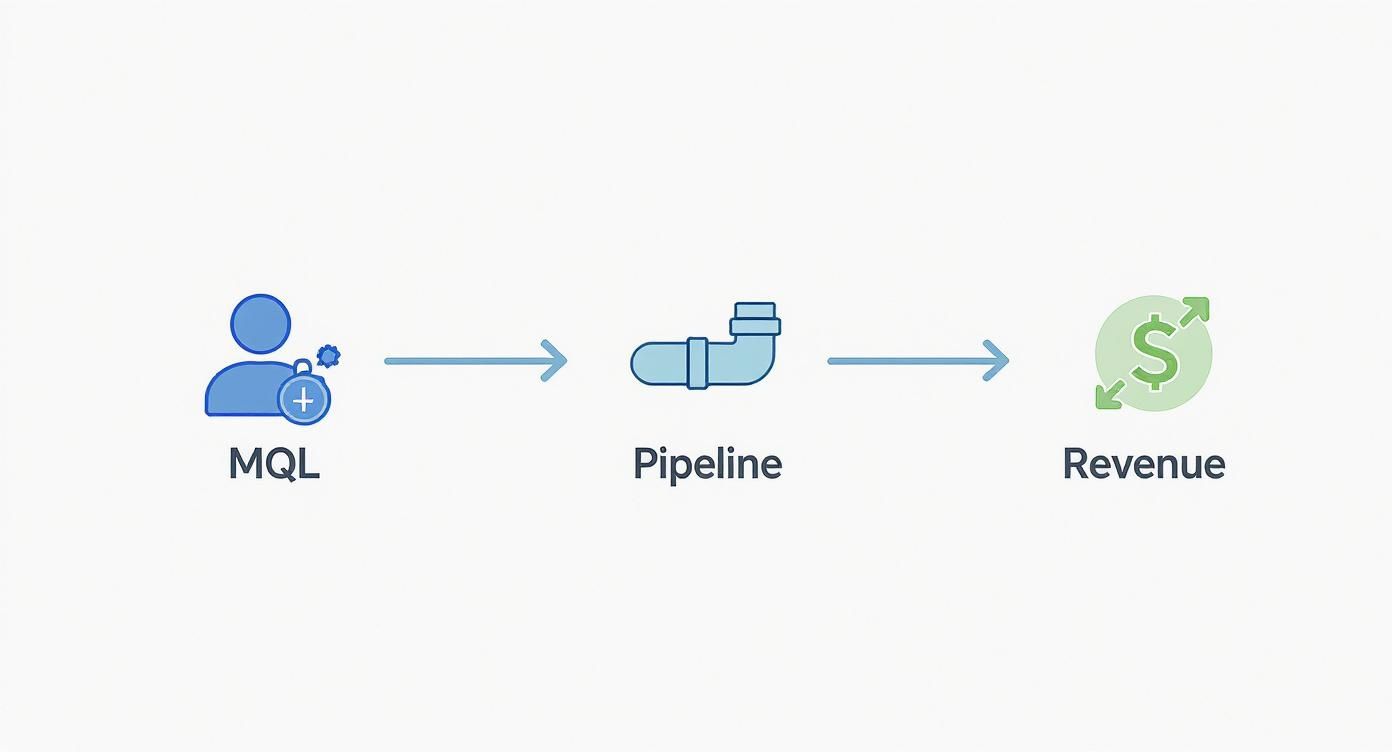 As you can see, a healthy flow of marketing-qualified prospects is the essential first step to building a revenue pipeline you can actually count on.
Step 4 Activate the Right Distribution Channels
Creating incredible content is only half the battle. If no one sees it, it doesn't matter. Your distribution strategy needs to focus on the channels where your ICP is already spending their time. Don't spread yourself thin trying to be everywhere at once.
Instead, pick a few key channels and go deep. For a lot of B2B companies, this means a strong focus on LinkedIn for both organic content and hyper-targeted ads. SEO is another non-negotiable, it's how you make sure your content shows up when prospects are actively searching for solutions. The key is to be consistently present and helpful where it matters most.
Step 5 Build a Seamless Nurture and Handoff System
Finally, you need a system to manage all the interest you've created. This is about nurturing prospects who aren't quite ready to buy and setting up a crystal-clear process for handing off qualified leads to the sales team. This is where marketing automation platforms become your best friend, letting you deliver personalized drip campaigns that keep your brand top-of-mind.
The handoff itself requires tight alignment between marketing and sales. Both teams absolutely must agree on the definition of a "sales-qualified lead" (SQL) to make sure the transition is smooth. When a lead gets passed to sales, it should come with a rich history of their engagement, giving the sales team the context they need to have a productive, relevant conversation.
Accelerating Results with Strategic Personalization
Let's be honest: in a crowded market, generic, one-size-fits-all messaging is the fastest way to get ignored. The real key to cutting through the noise in your B2B demand generation is strategic personalization, creating experiences that make your high-value prospects feel seen and understood from the very first click.
We're not talking about just dropping a `` into an email subject line. This is about tailoring the entire journey to a specific account’s world. When a prospect feels like you’ve actually done your homework, you instantly build a level of credibility and grab their attention in a way that generic outreach just can't match.
Personalization is what turns your marketing from a broadcast into a conversation. It shows a prospect you understand their specific world, which makes them far more willing to engage and hear what you have to say.
Making an Instant Connection
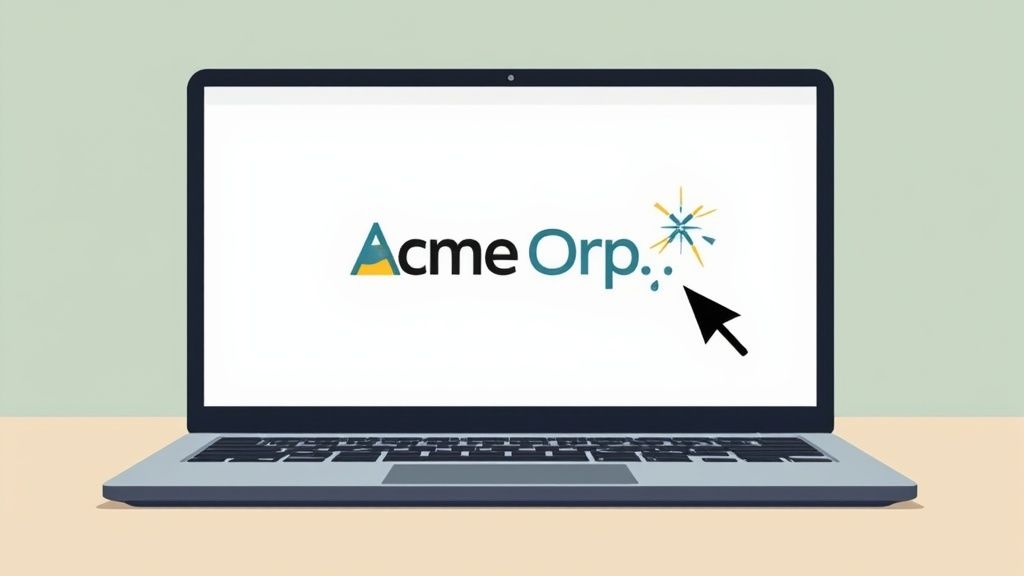
One of the most powerful moves you can make is to dynamically alter your digital assets in real time. Picture this: a decision-maker from your top target account, ‘Acme Corp,’ clicks on one of your ads. Instead of landing on the same old page everyone else sees, they arrive on a landing page that features their own company logo and a headline that speaks directly to their industry's pain points.
That creates an immediate "aha" moment. It's a clear signal of relevance and thoughtful targeting, transforming a cold click into a genuinely warm and engaging experience. This approach is a game-changer for:
- Account-Based Marketing (ABM): Greet your key accounts with landing pages and ads that reflect their own brand back at them.
- High-Intent Visitors: Double down on visitors showing strong buying signals by personalizing their experience, confirming you're the right solution for their business.
- Industry-Specific Campaigns: Tailor your visuals and messaging to resonate with the unique language and challenges of different vertical markets.
Boosting Conversions with On-Brand Experiences
Tools like Brand.dev make this slick, dynamic personalization surprisingly straightforward. By plugging in a brand API, you can automatically fetch a visitor's company logo, colors, and other brand assets the moment they land on your site.
Here’s a quick look at how a landing page can be instantly personalized with a prospect's own branding.
This simple but incredibly effective tactic replaces generic stock visuals with a prospect’s familiar branding, making the entire experience feel custom-built just for them.
This seamless integration does more than just impress people. It directly impacts your bottom line by building instant rapport, which leads to higher engagement, better quality leads, and, ultimately, a shorter, smoother sales cycle.
Answering Your B2B Demand Generation Questions
As you start mapping out a B2B demand generation strategy, a few questions always pop up. Getting straight answers to these is the key to building a program that actually works. Let's tackle them head-on.
How Much Should We Budget for Demand Generation?
There's no single magic number here. A good rule of thumb is to dedicate between 30% to 50% of your total marketing budget to your demand gen efforts.
Of course, this can swing depending on where you are as a business. An early-stage startup trying to make a splash might push that number higher, while a more established company might have a more predictable percentage locked in.
When you go to make the case for your budget, talk about outcomes, not activities. Don't ask for money for "ads." Frame it as an investment to "generate X qualified pipeline opportunities." Tying every dollar to potential revenue is how you speak the language of your CFO and get the resources you need.
How Is Demand Generation Different from Inbound Marketing?
This one trips a lot of people up, but it's actually pretty simple. Think of B2B demand generation as the overall blueprint for creating desire for your product in the market. Inbound marketing is one of the most important tools you use to execute that blueprint.
Inbound marketing is a core tactic used within a broader demand generation strategy. Inbound is all about pulling customers in with great content and helpful experiences, which is the perfect fuel for demand gen's goal of educating your market and building trust.
You really can't run a modern demand generation program without a solid inbound marketing engine, things like SEO, blogging, and social media. Inbound creates the value; demand generation aims that value at building a reliable revenue pipeline.
What Technology Do We Absolutely Need to Start?
You don't need a sprawling, complicated tech stack right out of the gate. In fact, it's better to start lean. But there are three foundational tools that are non-negotiable for running and measuring your program effectively.
This is the essential trio that will form the backbone of your entire operation:
- Customer Relationship Management (CRM): This is your single source of truth. It's where all your customer and prospect data lives, where you track conversations, manage the pipeline, and ultimately connect what marketing is doing back to actual revenue.
- Marketing Automation Platform: This is your workhorse. It handles the crucial, scalable tasks like email nurturing, building landing pages, and scoring leads so you can engage with your audience consistently and efficiently.
- Analytics Tools: You can't improve what you don't measure. Something like Google Analytics is essential for seeing what’s working on your website, which content is resonating, and where your conversions are coming from.
Ready to take your personalization to the next level? With Brand.dev, you can instantly create on-brand experiences for every visitor, boosting engagement and accelerating your sales cycle. See how it works at Brand.dev.