
Landing page personalization is all about creating a unique experience for every person who hits your page. Instead of showing everyone the same headlines, images, and calls to action, you dynamically adjust the content based on who they are and where they came from. The result? A message that feels incredibly relevant and drives way more conversions.
Why Personalization Is No Longer Optional
Think about a brick-and-mortar store. A good salesperson wouldn't greet a loyal customer the same way they greet a first-time window shopper. They’d tailor the conversation. For far too long, digital marketing has relied on the equivalent of a single, generic script for everyone who walks in the door.
Landing page personalization completely flips that outdated model. It’s a strategy that uses visitor data to build a persuasive, relevant experience on the fly. This goes way beyond just dropping a name into a headline; it’s about making your visitors feel seen and understood from the very first click.
The Big Idea: Context Is Everything
At its core, personalization acknowledges that every visitor arrives with a different story and a unique goal. Your job is to align your landing page with that context. This is done by swapping out page elements based on what you know about them. If you want to dive deeper into the nuts and bolts, this is a great read on what content personalization entails and how it boosts engagement.
This dynamic approach hinges on a few key data points:
- Traffic Source: Someone clicking a Google Ad for "small business accounting software" should land on a page that speaks directly to that need, a completely different message than for someone who came from a LinkedIn post about enterprise solutions.
- Location: A clothing retailer can show parkas and snow boots to a visitor from Anchorage while featuring swimwear for someone browsing from Miami.
- Past Behavior: A returning visitor who spent time looking at your "Team Collaboration" features? Greet them with a special offer or case study related to that exact feature.
- Firmographics: A B2B company can tweak its value props based on the visitor's industry, company size, or even their specific job title.
To really nail this down, let’s look at the tangible benefits this strategy brings to the table.
Table: Key Benefits of Personalizing Your Landing Pages
This table breaks down the core advantages of a personalization strategy, connecting each benefit to a real-world business outcome.
| Benefit | Impact on Business | Example |
|---|---|---|
| Increased Conversion Rates | More leads, sign-ups, and sales from the same amount of traffic. | A SaaS company personalizes its headline based on industry, leading to a 15% lift in demo requests. |
| Improved User Experience | Visitors feel understood and find what they need faster, reducing frustration. | An e-commerce site shows recently viewed items on the landing page for returning visitors. |
| Higher Engagement | Relevant content keeps visitors on the page longer and encourages interaction. | A publisher shows articles related to a visitor's location, leading to a 30% lower bounce rate. |
| Better Lead Quality | Tailored messaging attracts the right customers and filters out poor fits. | A B2B service adjusts its call-to-action based on company size, separating enterprise from SMB leads. |
| Stronger Brand Loyalty | A personalized journey shows you care about the individual, not just the transaction. | A travel site welcomes back a past customer with a message like, "Welcome back, Sarah! Ready for your next adventure?" |
Ultimately, a well-executed personalization strategy doesn't just feel better for the user, it directly impacts your most important metrics.
The Real Impact On Your Bottom Line
Shifting away from a generic, one-size-fits-all landing page isn't just a nice-to-have; it delivers real, measurable results. When a visitor lands on a page that speaks their language and addresses their specific problems, the decision to convert feels less like a sales pitch and more like a logical next step.
This isn't just a trend; it's a direct response to a fundamental shift in customer expectations. People today don't just appreciate personalization, they expect it. If you're not delivering it, you're leaving money on the table.
Personalization closes the gap between what a visitor wants and what you offer. It’s the most powerful way to boost relevance, and in today's world, relevance is what wins. This guide will walk you through exactly how to put this strategy to work.
Core Personalization Strategies That Actually Work
Alright, let's move past the theory. Knowing why you should personalize is one thing, but knowing how is where the magic really happens. This is where we get into the specific, actionable strategies that seasoned marketers use to make their landing pages click.
Think of these strategies as different lenses for viewing your audience. Each one uses a different piece of information about your visitor to sharpen the message, making it far more relevant and compelling.
Personalize Based On Traffic Source
Not all traffic is created equal. A visitor who clicks a super-specific Google Ad for "enterprise HR software" has a completely different mindset than someone who casually tapped a link in a social media post.
The key here is "message match." You want to continue the conversation that started with the ad or post, not force them to start a new one.
For example, if someone clicks a LinkedIn ad targeting enterprise HR leaders, they should land on a page with a headline like, "The Enterprise HR Solution Built for Scale." But if they came from a Facebook ad about "improving team morale," the headline should be closer to, "Boost Team Morale with Our All-in-One Platform." This simple alignment instantly tells visitors they're in the right place, which is huge for reducing bounce rates.
Leverage Geography for Local Relevance
Where in the world is your visitor? Knowing their location, be it country, state, or city, is a powerful signal for personalization. It lets you swap out offers, language, imagery, and even customer testimonials to create an immediate sense of local familiarity.
Imagine you're a national real estate company. Instead of a generic "Find Your Dream Home" headline, you can use geolocation to show:
- "Find Your Dream Home in Denver, Colorado" for a visitor from Denver.
- "Explore Luxury Condos in Miami Beach" for a visitor from Miami.
But it goes way beyond headlines. You can feature testimonials from local customers, show pricing in their local currency, or use images that reflect the local scenery. It makes a big, faceless brand feel like a neighborhood expert.
By speaking directly to a visitor's location, you transform a generic digital space into a familiar, localized experience. This simple shift can make your brand feel more approachable and trustworthy.
Use Visitor Behavior to Predict Intent
A person's past actions are one of the best clues to what they want next. Behavioral personalization uses data from a visitor's previous interactions with your site, like pages they've viewed, content they've downloaded, or products they've added to a cart, to customize what they see this time.
E-commerce sites are masters of this. If a returning visitor was just browsing hiking boots, greet them with a banner showcasing the newest arrivals in that exact category. For a B2B company, if a prospect previously downloaded an ebook on "Project Management for Startups," their next visit could highlight a case study from a startup that crushed its goals using your tool.
It’s a simple way of saying, "We're paying attention." In fact, personalized calls-to-action (CTAs) on landing pages convert 42% more visitors into leads compared to generic ones. That stat alone shows just how powerful it is to tailor your message based on what you already know they're interested in. You can dig into more landing page statistics to see the full impact.
Tailor B2B Messaging with Firmographics
For anyone in B2B, firmographic data is a goldmine. This is information about a visitor's company, like their industry, company size, or annual revenue. A one-size-fits-all message just doesn't cut it when you're selling to wildly different business segments.
Using a tool for reverse-IP lookup, you can often identify a visitor's company and adjust your landing page content on the fly.
- Industry: A visitor from a healthcare company sees a headline like, "HIPAA-Compliant Communication for Modern Hospitals."
- Company Size: A visitor from a Fortune 500 corporation gets shown enterprise-level features and case studies, while someone from a startup sees content about scalability and affordable pricing.
This approach lets you speak directly to the unique pain points and priorities of each business type. When you showcase industry-specific use cases and relevant social proof, you instantly build credibility and prove you understand their world. It’s a fast track to building trust and generating much higher-quality leads.
How to Bring Dynamic Content to Your Pages
Putting landing page personalization into action might sound like a huge technical hurdle, but the technology that drives it is surprisingly easy to get your hands on. The whole concept boils down to something called Dynamic Content Optimization (DCO). At its core, DCO is just a fancy term for a simple process: your website automatically swaps out elements, like headlines, images, or CTA buttons, in real time to match who's looking at it.
Think of your landing page not as one static document, but as a collection of smart, interchangeable blocks. With DCO, you create a few different versions of each block, then set up rules that tell your site which version to show to which visitor. You’re not building dozens of separate pages; you’re building one intelligent page that knows how to adapt.
A classic, powerful example is using URL parameters. Imagine a visitor clicks a paid ad for "project management software for small businesses." The URL they land on contains that information. Your DCO tool can read that parameter and instantly change the headline from a generic "Powerful Project Management" to the much more specific "The #1 Project Management Tool for Small Businesses." That immediate message match tells the visitor they’re in exactly the right place.
The Tools and Tech Behind the Magic
The good news is you don’t need to be a programmer to make this work. There’s a whole ecosystem of tools out there that do the heavy lifting, plugging right into your website to serve up dynamic content. They usually fall into a few main categories.
- All-in-One Marketing Platforms: Tools like HubSpot come with "smart content" features baked right in. These let you create different versions of your content based on things like a visitor's location, what device they're on, or their lifecycle stage in your CRM.
- Specialized Personalization Engines: Platforms like Optimizely or VWO are laser-focused on testing and personalization. They give you more advanced ways to segment your audience and run complex experiments to figure out which personalized variations actually move the needle.
- API-Driven Solutions: For more custom-built experiences, tools like Brand.dev offer APIs that let developers pull in brand data on the fly. This is perfect for B2B, where you can automatically theme a landing page with a visitor's company logo and colors, creating a seriously impressive "we built this just for you" moment.
Most of these platforms work by having you add a small snippet of JavaScript to your site. This little script is the brains of the operation, it analyzes visitors as they arrive, checks them against the rules you set, and makes the content swaps happen before the page even finishes loading.
Making It Work for Mobile Users
Optimizing for mobile isn't just a good idea anymore; it's essential. And personalization is a huge part of that. With smartphones driving more than half of all landing page traffic, a one-size-fits-all design is a surefire way to get a high bounce rate. In fact, dynamic landing pages that personalize content for mobile visitors convert 25.2% more effectively than static ones.
This diagram breaks down how different data sources come together to power this kind of real-time personalization.
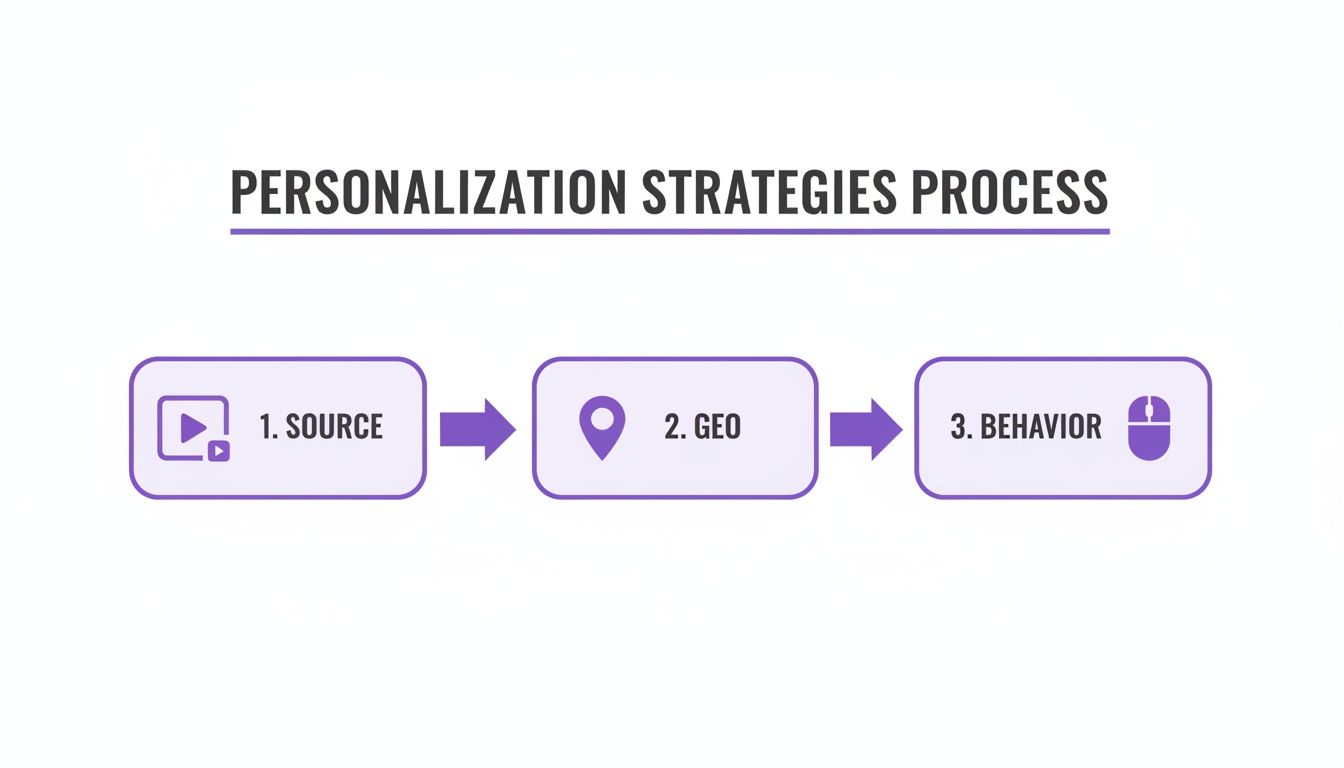
As you can see, it's about layering data. You start with the traffic source, add in geography, and then factor in user behavior to create an experience that feels incredibly relevant.
On mobile, this could be as simple as showing a shorter form that’s easier to fill out on a small screen. Or maybe you'd display a "click-to-call" button instead of a contact form. If you have physical locations, you could even use their geolocation to show a map with directions to the nearest store.
Figuring Out Who's Visiting
The big question is often, "How do you know who the visitor is?" While it's easy to identify someone who's already logged in, you can absolutely personalize the experience for new and anonymous traffic, too. Many tools can use a visitor's IP address to figure out their company and location.
The real power of dynamic content is its ability to turn anonymous traffic into an understood audience. By using contextual clues, you can deliver a relevant experience from the very first click.
This is often done with what’s called reverse-IP lookup technology. For instance, if you know a visitor is from a specific company in the healthcare industry, you can show them case studies and testimonials from that sector before they've even had a chance to fill out a form. To get a better grasp on this, check out our guide on how to identify anonymous website visitors.
Ultimately, all this tech comes together to create a seamless, tailored journey. It’s about making every visitor feel like you anticipated their needs, and that’s how you turn a good landing page into a great one.
Measuring Your Success with A/B Testing
So you’ve launched a personalized landing page. Great! But how do you actually know if it's working? Shipping a new page without a way to measure its performance is like sending a ship into the ocean without a compass. You’ve put in the hard work to create a tailored experience, but you need to turn your assumptions into hard data.
This is where A/B testing becomes your best friend.
At its core, A/B testing for landing page personalization is just a simple, scientific comparison. You don't just scrap your old generic page and hope for the best. Instead, you run the old and new versions side-by-side to see which one truly performs.
Your original, one-size-fits-all page is your control (Version A). The new, personalized version is your variant (Version B). By splitting your traffic between them, you get a clear, unbiased view of which experience actually moves the needle.
Identifying the Metrics That Matter
Before you can measure success, you have to define what it looks like. While every campaign has its own goals, a few key metrics are almost always in the spotlight when evaluating personalization.
- Conversion Rate Lift: This is the big one. What percentage of visitors took your desired action (like filling out a form or making a purchase) on the personalized page versus the control? Even a tiny lift can have a huge impact on ROI.
- Bounce Rate Reduction: Did the personalized content grab their attention and make them want to stick around? A lower bounce rate on your variant is a strong signal that the tailored message was more engaging from the get-go.
- Lead Quality: It’s not just about getting more leads; it’s about getting the right leads. Are the leads from the personalized page a better fit for your business? You can track this by seeing how many convert into qualified opportunities or customers down the line.
- Time on Page: More time spent on a page usually means deeper engagement. If visitors are hanging out longer with your personalized content, it’s a good sign they found it more compelling and valuable.
A/B testing isn't just about picking a "winner." It's about figuring out why a particular version won. Every test gives you valuable intel on what your audience wants, which you can pour back into your future campaigns.
To really get the most out of your tests, you need a solid grasp of conversion rate optimization best practices. This foundational knowledge will help you design smarter experiments and make better sense of the results.
Building a Continuous Optimization Loop
Personalization isn't a "set it and forget it" project. The most successful teams treat it as an ongoing cycle of improvement, constantly refining their strategy based on what they learn.
You can break this cycle down into four simple steps.
- Hypothesize: Start with an educated guess. For instance: "We believe that personalizing the headline for visitors from the healthcare industry will increase demo requests because it speaks directly to their pain points."
- Test: Fire up the A/B test. Send half your healthcare traffic to the control page with the generic headline and the other half to the variant with the new, industry-specific headline.
- Measure: Let the test run long enough to get statistically significant data. Dive into your key metrics, did the personalized version actually boost conversions?
- Iterate: If your hypothesis was right, fantastic! Roll out the personalized version to 100% of that audience segment. If it wasn't, no problem. Analyze why it didn't work, learn from it, and cook up a new hypothesis to test.
This simple framework turns what could be random acts of personalization into a data-driven growth machine. Every test, win or lose, teaches you more about what resonates with your audience, making every campaign after this one a little bit smarter.
Seeing Personalization Work in the Real World
Theory is great, but nothing beats seeing personalization drive actual results. When a company ditches the one-size-fits-all approach for an experience that speaks directly to the visitor, the impact on metrics is often immediate and massive. These examples are a solid blueprint for what's possible.
B2B companies, in particular, are crushing it with this strategy. Instead of a generic landing page, they're tailoring copy, use cases, and even social proof to match a visitor's industry or specific problem. It creates an instant sense of, "Ah, they get me."
The B2B Conversion Lift Blueprint
A killer example comes from the B2B client Docket. The marketing agency KlientBoost built a set of hyper-customized landing pages that pulled in a staggering 68% lift in conversions compared to their old, generic pages.
How’d they do it? By meticulously matching the page content to different audience segments. The copy mirrored the keywords from the ads that brought them there, and the value props directly addressed known industry pain points. You can dig into more stats like these and see the impact of tailored strategies over at involve.me's landing page statistics roundup.
This wasn't just a headline tweak. It was a full-funnel play where the ad, the landing page, and the final offer all told the same cohesive, personalized story.
The Docket case proves a crucial point: personalization isn't a "nice-to-have" feature. It's a core conversion strategy. It nails a visitor's intent so perfectly that clicking "convert" feels like the most natural next step.
This kind of detail turns a landing page from a digital brochure into a sales machine that has a one-on-one conversation with every prospect. For a deeper dive, check out this guide on a specific example of personalisation in action.
Personalization Across Different Industries
The playbook that worked for Docket isn't just for B2B SaaS. These same principles are being used to drive engagement and sales everywhere.
-
E-commerce Brands: Online stores use your browsing history to build a personal storefront just for you. If you were checking out running shoes last week, you might land on a homepage featuring the latest running gear and a special offer. The experience shifts from a manual search to a curated discovery.
-
SaaS Companies: It’s not just B2B. A project management tool might show one headline to a freelance designer ("Organize Your Projects and Wow Clients") and a totally different one to a student ("Ace Your Group Projects and Never Miss a Deadline"). Each one hits on a unique motivation.
-
Travel and Hospitality: Travel sites are the masters of geo-personalization. They’ll show you local deals, highlight popular destinations based on your location, and even switch up the imagery to match the current season where you are. It makes the idea of travel feel immediate and much more relevant.
All these examples share a common thread: they use data to close the gap between who the visitor is and what they see on the page. By understanding the visitor's context, these companies create experiences that feel less like marketing and more like a genuinely helpful conversation.
Scaling Personalization While Respecting User Privacy
So, you're seeing some great results and want to scale up your landing page personalization. This is where it gets interesting, and a bit tricky. As your program grows, you'll run into two major hurdles: how to manage all the moving parts without going crazy, and how to do it without creeping people out.
The best personalization strategies are built on a bedrock of trust. It’s a simple exchange: visitors give you information because they get something genuinely useful in return. This isn’t about tricking anyone; it's about being upfront with your data collection and sticking to regulations like GDPR and CCPA like glue.
Personalization should feel helpful, not like you're being followed around the internet. Get this balance right, and you'll build lasting loyalty. Get it wrong, and you'll lose trust you can probably never get back.
Building a Foundation of Trust
Let's face it, people are skeptical about how their data is used, and for good reason. Your entire personalization strategy needs to put privacy first, which means focusing on the data you collect directly from your audience. This is exactly where a solid first-party data strategy becomes your most valuable play.
Forget about creepy third-party cookies. The gold is in the information customers give you willingly. It’s more accurate, it's ethically sourced, and it builds a transparent relationship that people actually appreciate.
This isn't just a compliance checkbox, it's how you build a brand that people want to stick with. If you want to dig deeper into this, our guide on first-party vs third-party data collection breaks it all down.
Managing Your Strategy as It Grows
Once you start creating more and more personalized experiences, things can get messy fast. A single landing page could suddenly have dozens of variations for different industries, traffic sources, or company sizes. Without a system, you'll drown in complexity. This is where a clear framework and some smart automation come into play.
To keep things from spiraling out of control, stick to these practices:
- Go for the Biggest Wins First: Don't try to personalize everything at once. Zero in on your highest-traffic pages or your most valuable customer segments. Nail those, and you'll see a real impact right away.
- Create a Content Library: Think of it like a set of Lego bricks. Build a collection of reusable content blocks, headlines, testimonials, case studies, logos, and images, that you can easily swap into your pages on the fly.
- Embrace Automation and AI: Use your marketing automation tools to set up the rules and triggers for your dynamic content. AI can also be a huge help here, spotting patterns in performance data and suggesting new personalization ideas you might have missed.
By creating a system to prioritize, manage, and automate your work, you can build a personalization program that not only grows with your business but also keeps user trust at its core.
Got Questions? We've Got Answers.
Even the best personalization strategy comes with a few "what ifs." Let's tackle some of the most common questions that pop up when teams start personalizing landing pages.
Personalization vs. Customization: What’s the Real Difference?
It's easy to get these two mixed up, but the distinction is pretty important. Think of it like this:
Customization is when your visitor is in the driver's seat. They manually change their experience, like switching to dark mode or setting their language preference. The user does the work.
Personalization, on the other hand, is when the system does the work for them. The page automatically adapts based on what it knows about the visitor, like showing a New York-specific offer to someone in Brooklyn or different testimonials to someone from a fintech company. It's proactive, not reactive.
How Much Data Do I Actually Need to Start?
Probably less than you think. You don't need a mountain of data to get going. The trick is to start broad and get more granular over time. You can see big wins with just a couple of simple data points.
- Traffic Source: This is the easiest place to start. If someone clicks an ad about "fast accounting software," your headline should say "Fast Accounting Software." You can do this on day one with zero user data.
- Geolocation: IP address data is readily available and lets you greet visitors with a message relevant to their city, state, or country. It’s a simple touch that makes a big impact.
The goal isn't to wait for the perfect, complete dataset. It's to start with one or two high-impact signals, measure what happens, and build on that momentum.
Will Personalization Tank My SEO?
This is a huge, and valid, concern. The short answer is no, as long as you do it right.
Search engine crawlers like Googlebot see the default, non-personalized version of your page. So, as long as that default experience is fully optimized with your target keywords and provides a great experience, you're in the clear.
In fact, great personalization can actually help your SEO indirectly. When you create a more relevant experience, people stick around longer and bounce less. Those positive engagement signals tell search engines that your page is a high-quality result, which can give you a nice little boost over time.
Ready to create a truly one-to-one experience for your visitors? With Brand.dev, you can instantly pull logos, colors, and other brand data to personalize landing pages on the fly. Start building smarter, more relevant pages today at https://brand.dev.