
B2B tech marketing isn't just selling software to other companies. It involves navigating long, complex sales cycles where decisions are made by committee, and the focus is on solving real operational problems rather than satisfying a passing consumer want.
Understanding the B2B Tech Marketing Landscape
Selling a hammer to a homeowner is simple. It's a quick, low-cost transaction. That's consumer marketing. But selling a sophisticated, automated manufacturing robot to an engineering firm? That's a different situation entirely. It's a strategic investment that demands deep product knowledge, trust, and clear demonstration of long-term value.
Success in this space means understanding the unique realities that shape every campaign, every piece of content, and every sales call. You're not just selling a tool; you're selling a critical component of another company's growth, efficiency, or innovation engine. For a broader look at the fundamentals, this post on What is B2B Marketing is a great resource.
High Stakes and Complex Decisions
Rarely does one person make the final call in B2B tech. Instead, you're dealing with a buying committee, a group of people with different roles and wildly different priorities.
- The Technical Evaluator: This is your engineer or IT specialist. They're going to tear your product apart, scrutinizing its features, how it integrates with their existing stack, and its security protocols.
- The End-User: This is the person who will live in your software day-to-day. They care about one thing: usability. Does it make their job easier or harder?
- The Financial Decision-Maker: Think CFO or department head. Their world revolves around ROI, total cost of ownership, and whether this purchase fits the budget. They live and die by the spreadsheet.
- The Executive Sponsor: This is the C-suite champion who sees the big picture. They need to know that this investment aligns with the company's long-term strategic goals.
Your marketing has to speak to all these people simultaneously. Each one needs specific information to feel confident, and it's your job to provide it.
The Rise of the Self-Educated Buyer
Today's B2B buyers do their homework. A lot of it. In fact, they complete as much as 70% of their research on their own before they even think about talking to a sales rep. They're devouring blog posts, comparing vendors on G2 and Capterra, watching demos, and asking their peers for recommendations.
This means your digital presence is now your most important salesperson. Marketing's role isn't just about handing off leads anymore; it's about educating prospects and building trust throughout their entire self-directed journey.
This shift in buyer behavior makes content, transparency, and deep personalization non-negotiable. If your marketing doesn't provide clear answers and build confidence from the first click, you'll be out of the running before you even knew you were in the race.
Mapping The Modern B2B Tech Buyer Journey
The old sales funnel doesn't quite capture what's happening anymore. That neat, linear path from awareness to purchase rarely exists in today's B2B tech world. The modern buyer's journey looks more like a web of self-guided research, spanning months and involving dozens of digital and human touchpoints. It's a process driven by a committee, not an individual.
Trying to navigate this means you're not selling to a single person. You're selling to a group of stakeholders, each with their own priorities, pain points, and agendas. Your messaging has to resonate with each of them to move a deal forward. To really guide this process, you first need to get a handle on their experience, which starts with solid customer journey mapping.
The image below breaks down the three core truths that define this journey.
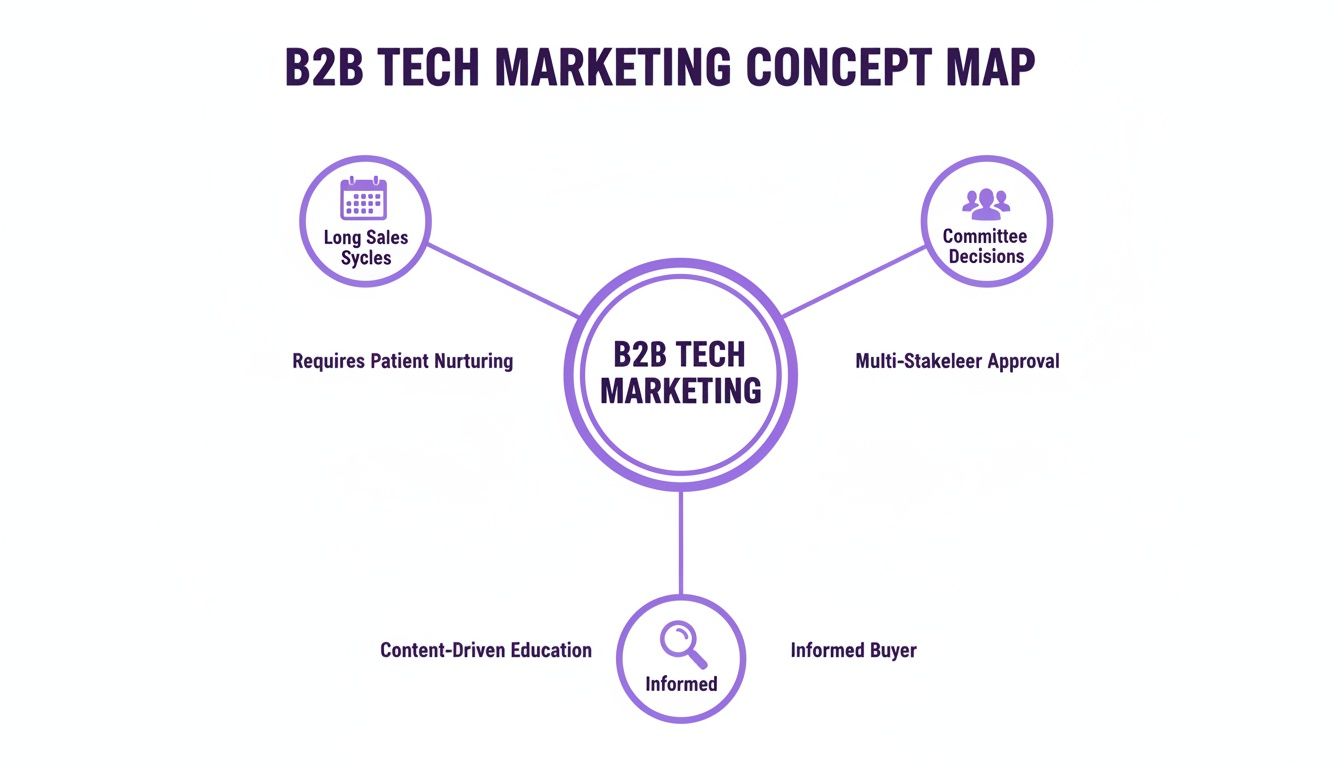
This map shows how longer sales cycles, group decisions, and the rise of the hyper-informed buyer all feed into each other, shaping every interaction you have.
The Key Players In The Buying Committee
Winning in B2B tech means understanding the different people on the buying committee. Each person has a critical role, and your content needs to speak directly to what they care about. Start by building a solid customer profile, and we have a useful ideal customer profile template to get you started.
Engaging Key Personas in the Tech Buying Committee
To really connect, you have to understand what each key player in a tech purchase is worried about and tailor your message accordingly. This isn't a one-size-fits-all conversation.
| Persona Role | What Keeps Them Up at Night | Content That Resonates |
|---|---|---|
| Technical Evaluator | Will this integrate with our stack? Is it secure and scalable? Does it actually work? | Technical documentation, API specs, sandbox environments, detailed case studies. |
| End-User | Is this going to make my job easier or harder? How steep is the learning curve? | Interactive demos, free trials, quick-start guides, user testimonials. |
| Financial Decision-Maker | What's the total cost of ownership? Can we prove a clear ROI on this investment? | Transparent pricing models, ROI calculators, competitive comparisons, business cases. |
| Executive Sponsor | How does this align with our strategic goals? Will it give us a competitive edge? | High-level vision decks, industry trend reports, thought leadership, success stories. |
Each of these conversations matters. Address them all well, and you're well on your way to closing the deal.
Navigating the Dark Funnel
A huge slice of the buyer's journey now takes place in the dark funnel. This is all the research, evaluation, and deliberation that happens before a prospect ever identifies themselves to your sales team. They're reading reviews, asking for advice in private communities, and consuming your content, all completely anonymously.
This anonymous research phase is where impressions are formed and trust is built, or lost. Your digital experience is your first, and sometimes only, chance to make a compelling case.
This is where a slick, self-serve digital experience becomes a massive advantage. It's not just about gating content anymore; it's about delivering immediate, tangible value. For example, an API like Brand.dev can create a "wow" moment from the first click by instantly personalizing a trial experience with a prospect's own logo and branding, fetched on the fly.
This trend toward self-service is only getting stronger. With Millennials now making up 59% of B2B buyers, digital-first is the new standard. In fact, Forrester predicts that by 2025, digital channels will handle over half of all large transactions, even those exceeding $1 million. This is precisely why a third of marketers are already using AI to segment audiences and deliver hyper-relevant experiences.
By meeting buyers where they are, deep in the dark funnel, with valuable, personalized interactions, you make a powerful impression long before a sales call ever gets booked.
Core Strategies for Your Marketing Playbook
A solid B2B tech marketing machine isn't built on a random collection of tactics. It's a playbook, a set of core strategies that work together to find and win over your ideal customers. The focus is on creating sustainable growth by educating your audience, targeting with precision, and letting the product's value speak for itself.
Here are the pillars of a modern strategy, starting broad and getting more focused. Each piece has its own role, but they work best when combined.
Drive Education and Trust with Content Marketing
In a world where buyers do most of their homework on their own, your content is your single most valuable asset. Content marketing in B2B tech isn’t about flashy ads; it's about becoming a trusted teacher. It's the engine that powers almost everything else you do.
The goal: answer your customer's biggest questions before they even think to ask them. This builds authority and keeps you top-of-mind when they're ready to make a decision. Great content isn't a sales pitch; it's helpful, insightful, and backed by data.
A strong content program mixes different formats for every stage of the journey:
- Top-of-Funnel Blog Posts: Tackle broad industry problems to attract a new audience.
- In-Depth Guides and Whitepapers: Offer detailed solutions for prospects who are actively researching.
- Technical Case Studies: Give decision-makers concrete proof of your product's value and ROI.
- Webinars and Demos: Show off what your product can do in a live, interactive setting.
By consistently putting out high-quality, relevant content, you create a powerful inbound magnet that draws in qualified leads and cements your reputation as a leader in your space.
Target High-Value Clients with Account-Based Marketing
While content marketing casts a wide net, Account-Based Marketing (ABM) takes a more targeted approach. Instead of marketing to a huge audience and hoping for leads, ABM starts with a specific list of high-value target accounts and treats each one like its own market.
This strategy is a perfect fit for B2B tech, where deal sizes are big and buying committees are complicated. It gets sales and marketing on the same page, focusing all their energy on the accounts that matter most, delivering a consistent and deeply personal experience.
An ABM approach means you stop spraying and start focusing. Every piece of communication, from ad creative to sales outreach, is tailored to the specific challenges and goals of the target account.
For example, you might spin up a custom landing page for a key account, run LinkedIn ad campaigns hitting specific job titles at that company, and send personalized emails that reference their industry and recent news. That level of detail shows you’ve done your homework and makes people pay attention.
Let Your Product Be Your Best Marketing Tool
Product-Led Growth (PLG) is a strategy where the product itself does the heavy lifting for acquiring, converting, and growing your customer base. Think about companies like Slack, Calendly, or Figma. You probably started using them with a free trial or a freemium plan, saw how valuable they were firsthand, and then became a paying customer.
PLG just makes sense for B2B tech. It lets smart buyers educate themselves and test out a tool on their own schedule. It cuts out the friction by putting the user experience first.
A successful PLG motion needs a few key things:
- A frictionless signup that gets people into the product instantly.
- A quick "aha!" moment where the user immediately gets the core value.
- A clear path to upgrade when they hit a limit or need more powerful features.
This approach builds a loyal user base that grows on its own, often through word-of-mouth. In a PLG world, marketing's job shifts to driving signups for the trial and making sure the onboarding is smooth and valuable.
Amplify Your Reach with Strategic Paid Media
Organic channels are crucial, but paid media is the accelerator. It lets you test messaging, speed up growth, and hit specific audiences with surgical precision. For B2B tech, platforms like LinkedIn are gold because of their incredible targeting options.
You can target users by company, job title, industry, seniority, and even skills, making sure your message lands right in front of the decision-makers you need to reach. The best paid campaigns often promote high-value content, like a webinar or an industry report, to pull in qualified leads.
Connect and Convert with Events
Even with everything going digital, events, both virtual and in-person, are still a huge part of B2B tech marketing. They give you a rare chance to build real relationships and talk to prospects in a focused setting. In fact, over 90% of marketers believe events deliver the most value in the middle and later stages of the sales funnel.
And it’s not just one or the other; 57% of marketers are now prioritizing hybrid events to get the best of both worlds. Whether it’s a massive industry conference or a small, curated roundtable, events accelerate deals by putting you face-to-face (or screen-to-screen) with the right people. They’re a powerful way to show your expertise and build the human connections needed to close complex tech deals.
Using AI and Personalization to Win Over Buyers
In B2B tech marketing, being the loudest voice in the room doesn't work anymore. What matters is being the most relevant one. AI is now a core part of the modern marketer's toolkit, used to create deeply personal experiences that grab a buyer's attention and build rapport.
This goes way beyond just slotting a first name into an email template. True personalization is about understanding a buyer's context, their company, their industry, their needs, and adapting their journey on the fly. For busy tech buyers with high expectations, this level of detail is a massive differentiator.
Beyond Basic Tokens to True Hyper-Personalization
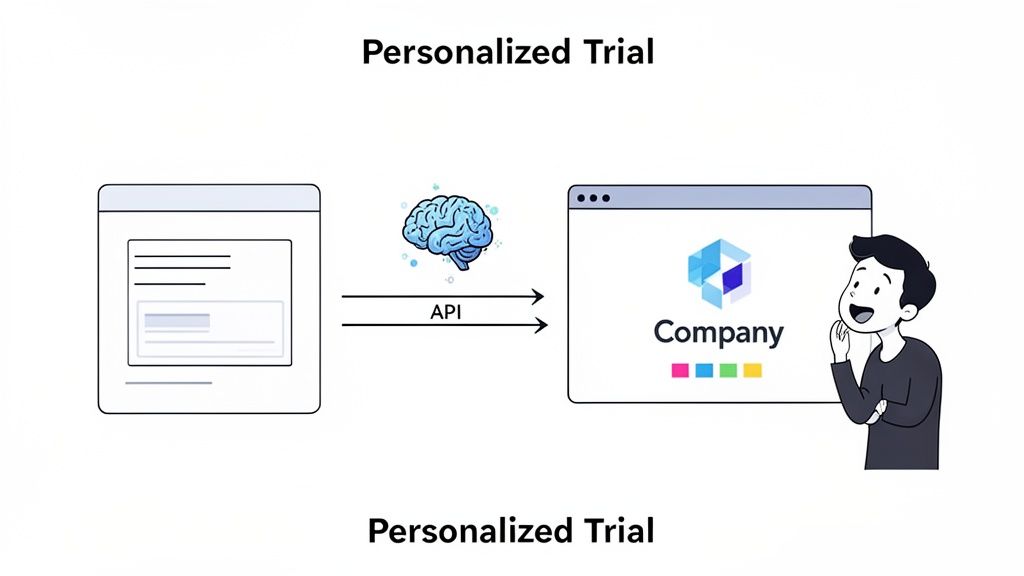
Hyper-personalization is about using AI and real-time data to craft experiences so specific they feel like they were built for just one person. Go beyond simple mail-merge fields. Consider a product trial that instantly rebrands itself with the user's company logo the second they sign up.
This is already possible. An API like Brand.dev can pull a company's logo, color scheme, and style guide just from their domain name. This lets a SaaS product automatically brand the entire onboarding flow for a new user, creating an immediate sense that you understand their world from the very first click.
This is the power of programmatic personalization. It transforms a generic product tour into a bespoke demonstration, making prospects feel seen and understood before a salesperson ever enters the conversation.
This strategy addresses a core challenge in B2B tech: proving value quickly. When a prospect sees your product already wearing their own brand's colors, it feels familiar, tangible, and more valuable.
Practical Applications of AI in B2B Tech Marketing
AI is a set of capabilities that can be woven throughout the entire buyer journey. Marketing teams are using it to get more done with less effort.
Here are a few high-impact applications:
- Predictive Lead Scoring: AI models sift through thousands of data points, from website clicks to company size, to pinpoint which leads are actually ready to talk. This lets sales teams focus their energy where it counts.
- Dynamic Content Creation: AI can spin up personalized ad copy, landing pages, and email subject lines based on a visitor's industry, role, or browsing history. It ensures the message always lands right. Check out our guide on generative AI tools for marketing to see what's possible.
- Intelligent Chatbots and Assistants: Today's chatbots do more than just answer FAQs. They can qualify leads, book meetings, and guide users to the right resources 24/7, providing instant help without human intervention.
The growth here is undeniable. The global AI in marketing market is expected to rocket to over $107.5 billion by 2028. And it's not just hype, 57% of B2B marketers are already using AI-powered chatbots to improve demand gen and get a deeper read on their audience.
Personalization at the Point of Conversion
The most critical moments for personalization often happen at the bottom of the funnel, right when friction can kill a deal. AI helps smooth out that final mile from evaluation to purchase.
Here are a few developer-focused use cases:
- Automated Onboarding Flows: A new user signs up. An API instantly enriches their profile with company data, triggering a customized onboarding checklist that highlights use cases relevant to their specific industry.
- Enriched Transaction Records: For fintech or billing platforms, automatically adding a company's logo to invoices and transaction histories makes financial docs look professional and feel trustworthy.
- On-Brand Asset Generation: LLM-driven tools can use fetched brand data to instantly create marketing assets, like social media graphics or ad banners, that are perfectly consistent with a prospect's own visual identity.
Using AI in your B2B tech marketing strategy is about closing the gap between your product and the buyer's reality. It shows you've done your homework and proves your value in a way that generic, one-size-fits-all marketing can't.
How to Build Your B2B Marketing Tech Stack
An ambitious strategy is just a dream without the right tools to bring it to life. Your marketing technology (martech) stack is the engine that powers your entire operation, automating tasks, crunching data, and creating the kind of seamless experiences buyers now demand. Building a modern stack isn't about collecting logos; it’s about choosing interconnected tools that solve specific problems and work together as a single, cohesive system.
Think of a well-built stack as the central nervous system for all your marketing activities. It ensures data flows smoothly from one platform to another, giving you a complete picture of the customer journey and empowering your team to act on insights in real-time.
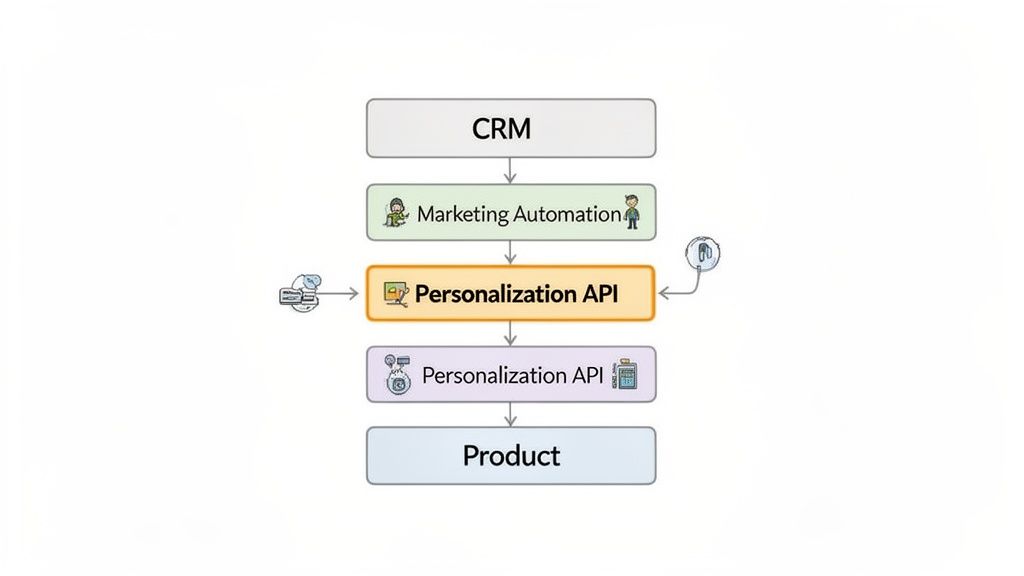
Core Components of a Modern Stack
Every B2B tech marketing stack looks a little different, but most are built on a few foundational pillars. These are the core systems handling the heavy lifting of managing relationships, automating communications, and measuring what actually works.
For any growing tech company, these categories are non-negotiable:
- Customer Relationship Management (CRM): This is your single source of truth for all customer and prospect data. Tools like Salesforce or HubSpot are essential for tracking every interaction, managing the sales pipeline, and keeping your sales and marketing teams on the same page.
- Marketing Automation Platform: This is where you build, manage, and scale your campaigns. Platforms like Marketo or Pardot handle email nurturing, lead scoring, and landing pages, letting you engage prospects without drowning in manual work.
- Analytics and Business Intelligence: Measurement is essential. Analytics tools like Mixpanel or Google Analytics track user behavior in your product and on your site, while BI platforms help you connect marketing activities directly to revenue.
These three pieces form the backbone of your operations. They provide the structure you need to execute your strategy and prove its impact.
The New Essential Layer: Personalization APIs
While the core systems are crucial, more teams are adding a new layer to their stack: personalization and enrichment APIs. These tools help create dynamic, hyper-relevant experiences that make a product feel indispensable from the very first click.
A personalization API is no longer a nice-to-have; it's a competitive necessity. It automates the kind of bespoke experiences that used to require massive engineering effort, giving you an outsized impact on engagement and conversion.
Think of an API like Brand.dev as a powerful plug-in for your entire stack. It enriches your CRM and marketing automation data with real-time brand information, all by using a prospect's email domain.
This unlocks new possibilities for automation and relevance:
- Automated Onboarding: A user signs up for a trial. The API instantly fetches their company logo and brand colors, theming the entire product experience for them automatically. No manual setup needed.
- Enriched Lead Profiles: New leads entering your CRM are immediately appended with rich company data. Your sales team gets valuable context without spending a single minute on research.
- Dynamic Content Generation: Your marketing automation platform can pull brand assets directly from the API to create personalized landing pages or ad creative on the fly.
Integrating these APIs frees up your team from repetitive manual tasks. Instead of chasing down logos or digging for company details, they can focus on what matters: building an effective B2B tech marketing strategy.
Measuring What Matters for B2B Tech Growth
So, how do you prove your B2B tech marketing is actually moving the needle? It's easy to get bogged down in a sea of clicks, impressions, and likes, metrics that might look impressive on a slide but don't mean a thing to the C-suite. The real challenge is shifting the conversation from marketing being a cost center to being the primary engine for revenue.
That means a ruthless focus on the handful of key performance indicators (KPIs) that tie your team's work directly to the bottom line. It's about speaking the language of the business, revenue, cost, and growth, and building a dashboard that tells a clear, compelling story about your impact.
From Vanity Metrics to Revenue KPIs
The first step is to stop chasing surface-level numbers. While metrics like website traffic and social media engagement have their place, they don't show financial impact. True performance is measured with KPIs that track the entire journey from initial investment to long-term profitability.
Here are the essentials every B2B tech marketer should have on their dashboard:
- Customer Acquisition Cost (CAC): This is the total cost of your sales and marketing efforts to acquire one new customer. A low CAC is a clear sign of an efficient marketing engine.
- Lifetime Value (LTV): This metric represents the total revenue a business can expect from a single customer account over time. A high LTV points to a sticky product and a healthy business model.
- The LTV to CAC Ratio: This is the gold standard. A healthy ratio, typically 3:1 or higher, proves your marketing isn't just acquiring customers, it's acquiring profitable ones that stick around.
- Pipeline Velocity: This measures how quickly deals move through your sales pipeline from lead to close. A faster velocity means marketing and sales are in sync and revenue is hitting the books sooner.
Building Your Performance Dashboard
Your measurement framework shouldn't be a static report you glance at once a month. It needs to be a living tool that you use to make data-driven decisions, optimize your budget, and communicate your team’s value. If you want to dive deeper into building this out, our guide on what is marketing analytics offers a solid foundation.
A great dashboard doesn't just report numbers; it provides answers. It should clearly show how marketing activities are influencing pipeline and revenue, turning raw data into actionable insights for the entire organization.
By tracking these core KPIs, you can confidently show that your B2B tech marketing program isn't just generating leads, but is a predictable and scalable driver of business growth.
A Few Common B2B Tech Marketing Questions
Even with a solid playbook, you're going to run into specific questions. Here are a few of the most common ones.
How Is B2B Tech Different From B2B SaaS Marketing?
Think of B2B tech marketing as the big umbrella and B2B SaaS marketing as a highly specialized discipline living under it. They're definitely related, but not the same thing.
B2B tech is the whole universe, it covers everything from cloud infrastructure and hardware to deep tech AI models. These often come with massive price tags, significant capital investment, and sales cycles that can stretch for a year or more. On the other hand, B2B SaaS marketing is hyper-focused on software sold as a subscription. The playbook there is all about product-led growth (PLG), fighting customer churn, and obsessing over metrics like monthly recurring revenue (MRR).
Still, the core job is the same: you have to educate a deeply technical buyer and build trust. That's the common thread.
What Is the Single Most Important Metric to Track?
If you could only track one thing, Marketing-Sourced Pipeline would be it.
This metric directly ties every marketing activity to potential revenue. It answers the question executives actually care about: "Is marketing driving the business?" It's far more useful than tracking top-of-funnel metrics like leads or MQLs.
When you pair this metric with Customer Acquisition Cost (CAC) and Lifetime Value (LTV), you get a financially-grounded view of your marketing engine's health and efficiency. It reframes the conversation from marketing being a "cost center" to a predictable driver of revenue.
How Can Small Tech Startups Compete with Large Enterprises?
You can't outspend the giants, so you have to outsmart them. Success isn't about budget; it's about being agile, focused, and personal.
Instead of trying to reach everyone, startups need to pick a very specific niche and a well-defined ideal customer profile (ICP). The goal is to dominate that niche.
Startups win by creating superior user experiences that larger, slower competitors can't easily replicate. Agility and personalization are the ultimate competitive advantages.
Modern tools can give startups an edge here. For example, a small team can use an API like Brand.dev to instantly personalize a product trial with a user's own company branding the second they sign up. This creates an immediate connection.
That kind of high-touch, automated personalization drives word-of-mouth growth that big marketing budgets can't always buy.
Ready to create these personalized experiences? With Brand.dev, you can instantly personalize your product experiences, enrich user profiles, and automate on-brand asset generation. Start building for free at https://brand.dev.