
NAICS and SIC codes are like a company's industry DNA. They tell you what a business actually does so you can analyze, compare, and target companies with precision.
TL;DR
- NAICS = modern, official standard used by governments and serious economic analysis.
- SIC = legacy but still critical, especially for historical data and many sales/marketing databases.
- You need both if you care about accurate targeting, risk, or market sizing.
This guide is for B2B marketers, sales and RevOps teams, data and analytics teams, lenders, and founders who are:
- Building or buying B2B prospect lists.
- Enriching CRMs or customer data.
- Doing market analysis, TAM sizing, or underwriting.
Your Business DNA: Making Sense of NAICS and SIC Codes

Imagine walking into a massive library with no Dewey Decimal System. Finding one specific book would be a nightmare. That's what the economy would feel like without industry classification codes. Systems like NAICS and SIC bring order to the chaos, neatly categorizing every business so you can analyze, compare, and target companies with real precision.
These codes are way more than just numbers on a government form; they're powerful strategic tools. Are you a B2B marketer trying to nail down your ideal customer? A lender assessing risk in a particular sector? An analyst benchmarking a competitor? These simple numeric codes provide the fundamental context you need to get the job done right.
Why You Still Need to Know Both Systems
In 1997, the government rolled out the North American Industry Classification System (NAICS). It was a joint effort between the U.S., Canada, and Mexico to create a more detailed and modern replacement for the old Standard Industrial Classification (SIC) system. With its six-digit structure, NAICS covers over 1,000 unique industries and is the official standard for all federal agencies.
But the old four-digit SIC code, which dates all the way back to the 1930s, is far from dead. Even though the government stopped updating it, private data companies picked it up and ran with it. They've expanded it into hyper-specific 8-digit codes that are deeply embedded in the sales and marketing world. You can get a great breakdown of their evolution and structure in this detailed comparison.
In short: NAICS gives you the official, modern map of the economy. SIC offers a historical lens and a specialized toolkit for private-sector data. Mastering both gives you a serious competitive advantage.
This dual-system reality means your business needs to be bilingual, fluent in both NAICS and SIC. Knowing how to find the right codes, and translate between them, is crucial for everyday tasks:
- Targeted Marketing: Building laser-focused prospect lists based on niche industries.
- Risk Assessment: Evaluating the financial health and stability of specific sectors.
- Government Contracting: Staying compliant with federal and state bidding requirements.
- Market Analysis: Understanding the competitive landscape and spotting growth opportunities before anyone else.
The Old Guard vs. The New Standard
To really get a handle on business classification, you have to see the NAICS code and SIC code systems side-by-side. Think of SIC as a classic sedan from the 1980s, it was reliable and everyone knew how it worked, but it was built for a totally different era. NAICS is the modern electric equivalent, designed from the ground up to navigate today's complex, service-heavy economy.
The most obvious difference is their structure. The SIC system uses a four-digit code, which just doesn't have the room to capture all the nuances of modern business. NAICS expands this to a six-digit code, giving you a much more detailed and granular view of the market. This isn't just about adding more numbers; it's about reflecting economic reality.
Structure Defines Capability
The limits of the old SIC system become painfully obvious when you look at today's industries. Sectors like information technology, biotech, and specialized professional services simply didn't exist in their current form when SIC was king. The system struggles to categorize these businesses, often lumping them into broad, outdated buckets that don't make much sense anymore.
NAICS was designed to fix this exact problem. The jump from SIC to NAICS doubled the number of broad industry groups, allowing for a level of detail that actually matches the modern economy. Where SIC's four-digit codes topped out, the six-digit structure of NAICS opened the door for hundreds of new business types, especially in the fast-growing service sectors that SIC barely acknowledged. You can get a deeper dive on this evolution and its impact on industry classification for a modern economy.
This extra detail is why NAICS is the official standard for federal agencies in the U.S., Canada, and Mexico. It provides a common language for looking at economic data across North America, something SIC was never built to do.
A Practical Comparison
Let’s lay out the core differences. Knowing these distinctions is key to deciding which system makes sense for your goals, whether that's market research, B2B marketing, or government compliance.
Key Differences Between SIC and NAICS Codes
Here’s a simple table to see how the two systems stack up against each other.
| Attribute | SIC Code | NAICS Code |
|---|---|---|
| Structure | 4-digit numeric code | 6-digit numeric code |
| Hierarchy | 10 broad divisions | 20 broader sectors |
| Geographic Scope | U.S. only | U.S., Canada, and Mexico |
| Official Status | Phased out by U.S. government in 1997 | Current official standard for federal agencies |
| Industry Focus | Manufacturing and goods-producing economy | Service, technology, and emerging industries |
| Updates | No longer updated by the government | Reviewed and updated every five years |
At a Glance: When to Use NAICS vs SIC
-
Use NAICS when:
- Filing with government agencies (taxes, SBA loans, federal contracts).
- Doing modern economic or market analysis in North America.
- Building new data products or models that need a current standard.
-
Use SIC when:
- Working with historical data (especially pre-1997) or long time series.
- Using legacy sales and marketing databases that are SIC-based.
- You need hyper-granular niche targeting from 7–8 digit private SIC extensions.
Ultimately, it comes down to what you're trying to accomplish.
The key takeaway is simple: NAICS offers precision and relevance for today's economy, while SIC provides historical context and depth, especially in private marketing databases. Knowing when to use each is a strategic advantage. For any new government-related work or modern economic analysis, NAICS is the only choice. However, for historical data or tapping into established B2B lists, SIC remains indispensable.
Finding the Right NAICS and SIC Codes for Any Business
Nailing down the right NAICS and SIC code for a business is a must-do for sharp market analysis, targeted lead generation, or just staying compliant. It might seem a bit daunting at first, but there are a few solid ways to get it done, each with its own sweet spot.
Whether you're just sizing up one competitor or trying to enrich a giant customer list, a good strategy is everything. Now that you understand the high-level differences between NAICS and SIC, the next step is simple: how do you actually find the right code for a given business?
The process usually kicks off with a simple manual search, which is great for one-offs. From there, you can move up to official government tables or jump straight to automated tools for the heavy lifting.
Let's walk through these three proven paths.
The Manual Lookup Method
The most straightforward way to find a NAICS code is by going right to the source: the U.S. Census Bureau website. Their free online tool lets you search with simple keywords. Type in "software development," for instance, and you'll get a handful of potential codes. The real trick is to zero in on the company's main revenue stream, as that’s what truly defines its classification.
You can do the same for SIC codes using resources from OSHA or various private data providers. The approach is identical, start with a few keywords that best capture what the business does. This hands-on method is a fantastic way to get a real feel for how both systems are structured.
Pro Tip: When you're searching, start broad and then drill down. If a term like "automotive" gives you too many options, try getting more specific with "automotive repair" or "used car dealer" to find the perfect match.
Using Concordance and Mapping Tables
So, what happens when you have a SIC code but need the modern NAICS version? Or the other way around? This is where concordance tables come in clutch. The U.S. Census Bureau publishes official tables that act as a Rosetta Stone, mapping codes between the two systems. They’re indispensable for updating historical data.
Just be ready for a bit of complexity. As we'll get into later, the translation isn't always a clean, one-to-one swap. A single SIC code can sometimes splinter into several different NAICS codes, so you'll have to do some digging to figure out which one fits the specific business activity.
Automated API-Driven Lookups
Let’s be honest, manual lookups and cross-referencing tables just don't scale. When you're dealing with hundreds or thousands of companies, you need a modern, automated solution. This is where company enrichment APIs change the game, giving you a lightning-fast way to pull both NAICS and SIC codes with a single query.
These tools are built for speed and precision, making them perfect for:
- Enriching your CRM or marketing platform on the fly.
- Slicing and dicing large datasets for market segmentation.
- Fueling financial models or risk assessment algorithms.
For example, a developer could plug into a tool like the Brand.dev NAICS Industry Classification API to programmatically fetch accurate industry data for any company. It turns a tedious, error-prone task into a seamless, automated workflow, making sure your data is always on point.
Bridging the Gap: How to Map SIC to NAICS Codes
Trying to translate between SIC and NAICS codes isn't as clean as swapping one number for another. It’s less like translating a single word and more like interpreting a complex phrase between two different languages. The context shifts because NAICS was built from the ground up to capture a detailed, modern economic picture that the old SIC system just wasn't designed for. A perfect one-to-one match is the exception, not the rule.
This mismatch comes down to the fundamentally different philosophies behind the two systems. The move from SIC to NAICS involved a massive restructuring of industry categories. In fact, a full reconciliation analysis shows just how deep the changes went.
For instance, only about 220 of the lowest-level industry classes stayed the same. The study also highlighted that NAICS puts a much stronger emphasis on the knowledge economy, with 62 out of 108 codes studied consisting entirely of technology and advanced service activities, areas the SIC system often lumped into broad, generic buckets.
Understanding the Four Mapping Scenarios
To get from an SIC code to a NAICS code without messing up your data, you have to understand the four ways they can relate. Each one presents a different kind of challenge.
- One-to-One: The dream scenario. A single SIC code maps directly to a single NAICS code. It's clean, simple, and unfortunately, pretty rare.
- Many-to-One: This happens when several related SIC codes get rolled up into one, broader NAICS code. Think of it as NAICS tidying up by grouping similar legacy industries under a more unified modern umbrella.
- One-to-Many: This is where things get interesting. One general SIC code often explodes into multiple, more specific NAICS codes. This is a direct result of the incredible detail NAICS provides.
- Split Mapping: The messiest of them all. A single SIC code gets carved up, with its different business activities sprinkled across several unrelated NAICS codes. This requires the most careful handling.
Let's look at a classic one-to-many example. The old SIC code 7371, "Computer Programming Services," was a giant catch-all for pretty much anything related to software back in the day.
In the switch to NAICS, this single code was fractured into multiple, more precise categories. This move perfectly illustrates the power of NAICS: it provides deeper, more actionable insights by recognizing that not all "software" companies do the same thing.
Why Direct Conversion Is a Minefield
The breakup of SIC 7371 shows exactly why a simple lookup table often fails. A company filed under that one SIC code could now land in several different NAICS codes, all depending on what it actually does. A business that ships boxed software is fundamentally different from a consultancy that builds custom databases, and NAICS rightly separates them.
To show just how complex this can get, here is a breakdown of common mapping scenarios you might run into.
Sample SIC to NAICS Mapping Scenarios
The table below gives a few real-world examples of how SIC codes translate to NAICS. Notice how a single SIC can splinter into multiple NAICS codes, requiring you to know more about the business to map it correctly.
| SIC Code & Description | Mapping Type | NAICS Code & Description |
|---|---|---|
| 7371 Computer Programming Services | One-to-Many | 541511 - Custom Computer Programming Services 511210 - Software Publishers 541512 - Computer Systems Design Services |
| 5411 Grocery Stores | One-to-One | 445110 - Supermarkets and Other Grocery Stores |
| 2752 - Commercial Printing, Lithographic 2754 - Commercial Printing, Gravure 2759 - Commercial Printing, NEC | Many-to-One | 323111 - Commercial Printing (except Screen and Books) |
| 5941 Sporting Goods Stores and Bicycle Shops | Split Mapping | 451110 - Sporting Goods Stores 451120 - Hobby, Toy, and Game Stores 441228 - Motorcycle, ATV, and All Other Motor Vehicle Dealers |
This table makes it crystal clear: context is everything. You can't just grab the first NAICS code you see that looks related to SIC 7371. You have to know whether the company's main source of revenue is custom coding, selling pre-packaged software, or designing IT systems.
Without that extra layer of business detail, you’re just guessing. And guessing is a surefire way to misclassify companies and pollute your data.
The diagram below shows the kind of relationships you'll run into when you try to map from the old SIC system to the newer NAICS framework. It’s not always a clean one-to-one swap.
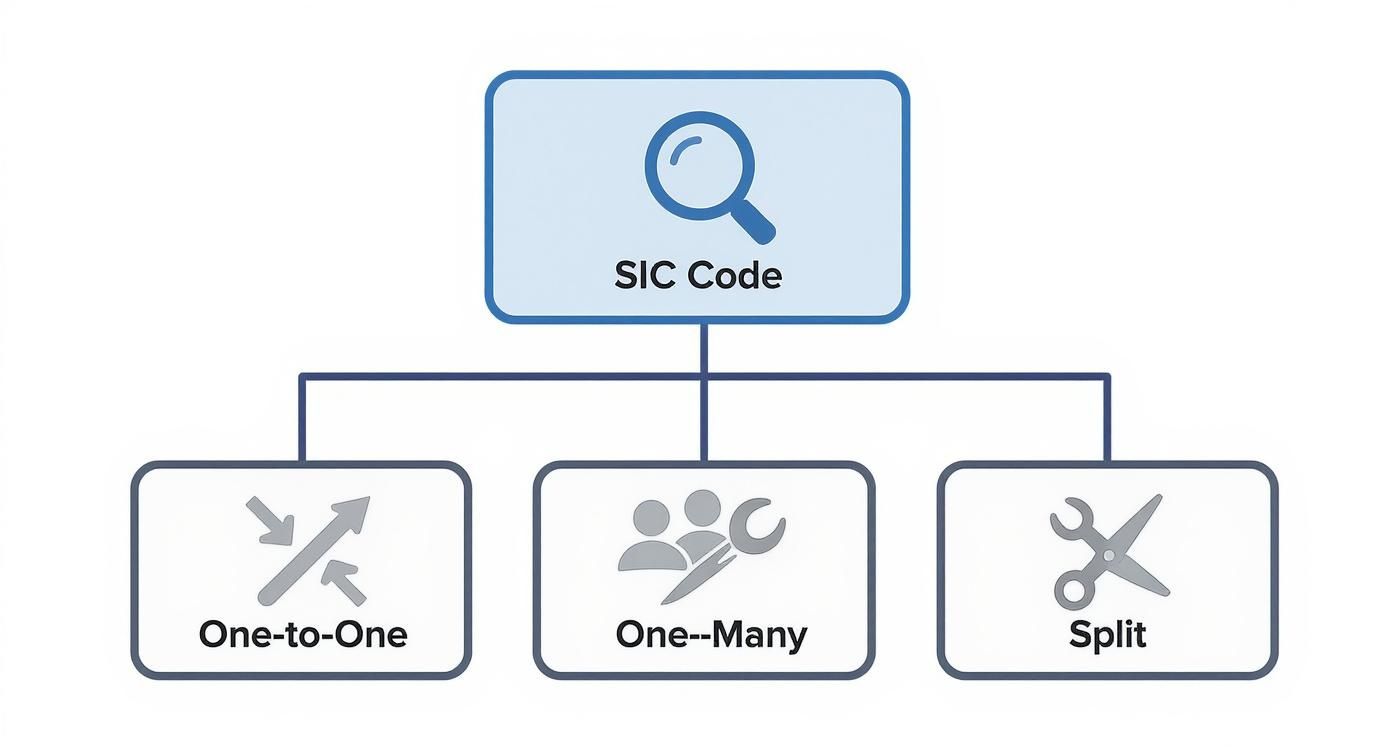
As you can see, while some mappings are straightforward, a lot of the legacy SIC codes actually splinter into several, more specific NAICS codes. You have to be careful with the translation.
Putting NAICS and SIC Codes to Work
Knowing what NAICS and SIC codes are is one thing. But turning them into a real strategic asset? That’s where the magic happens. Smart businesses use these codes across all sorts of functions, turning abstract numbers into hard, actionable intelligence that gives them a competitive edge.
Take B2B marketing, for example. For a SaaS company, these codes are the bedrock of good targeting. They can use a NAICS code like 511210 (Software Publishers) to instantly build a laser-focused list of prospects. This cuts out all the noise from irrelevant industries, making sure the sales team is only talking to companies that actually need their product.
Fueling Financial and Data Strategies
Financial analysts live and breathe these codes, especially for risk assessment and benchmarking. When a bank gets a business loan application, the company's NAICS code gives them immediate industry context. Lenders use it to understand sector-specific risks and stack the applicant's financials against industry averages. For investors doing fundamental analysis, these codes are non-negotiable for understanding where a company sits in the competitive landscape.
Data enrichment is another powerhouse application. Marketing teams and data agencies append NAICS and SIC codes to their customer databases to build out incredibly detailed audience segments. When you know a customer's industry, you can ditch the generic campaigns and start sending personalized messages and product recommendations that actually land. This is often done using a modern company data API that plugs right in and automates the whole process.
Key Takeaway: The real value of a NAICS/SIC lookup isn't just about finding a number. It's about unlocking a deep understanding of a company's core business, which then fuels smarter marketing, sharper financial analysis, and way richer datasets.
Actionable Use Cases Across Teams
The practical uses for these codes ripple out across the entire organization, proving just how essential they are to day-to-day operations.
- Sales Teams: Can slice and dice leads by industry to focus their energy on the sectors that have the highest conversion rates and best lifetime value.
- Compliance Departments: Use codes to make sure the business is sticking to government regulations, which is especially critical in high-risk industries like finance or automotive sales.
- Product Development: Can analyze industry trends to spot unmet needs, guiding the creation of new features or services that are perfectly tailored to specific sectors.
Choosing the Right Code System for Your Goals
Deciding between a NAICS code and a SIC code isn’t really about which one is better. It’s about picking the right tool for the job. Each system plays a distinct, vital role in modern business, and knowing how to speak both languages is a huge advantage.
When it comes to anything involving the government, NAICS is non-negotiable. If you’re bidding on a federal contract, applying for an SBA loan, or filing your official tax documents, you have to use the current NAICS code. It’s the official language of North American government agencies, giving them the detailed, modern classifications they need for statistical analysis and regulatory compliance. There's no way around it.
When to Stick with SIC
But that doesn’t mean SIC codes are obsolete. Far from it. They’re still indispensable for historical data analysis and a lot of private-sector marketing. Many of the legacy B2B marketing databases and analytics platforms were built on the back of SIC codes.
So, if you're digging into market trends from before 1997 or working with a purchased marketing list, you’ll almost certainly run into SIC codes. On top of that, private data providers have expanded the original SIC system into super-granular 8-digit codes, letting you target niche industries that NAICS simply doesn't cover.
The core lesson here is that modern businesses need to be bilingual. You have to use NAICS for official reporting and modern analysis, but you’ll lean on SIC for historical context and to tap into powerful legacy marketing databases.
Ultimately, the choice just comes down to your application. Are you trying to define your total addressable market for a new software product? You’ll probably want the modern precision of NAICS. For a deeper dive on using these codes in market sizing, check out our guide on how to calculate your TAM.
By understanding the specific strengths of both systems (NAICS and SIC), you can confidently pick the right one for any project, ensuring you get accurate and effective results every single time.
Frequently Asked Questions About NAICS and SIC Codes
As you start working with industry classifications, a few common questions always seem to pop up. Getting the hang of how NAICS or SIC codes are applied in the real world can clear up a lot of confusion, especially when you're looking at companies with diverse operations or digging into historical data.
Let's tackle some of the most frequent ones.
Can a Business Have More Than One Code?
Yes, absolutely. It's actually pretty common.
While every business gets one primary NAICS or SIC code that points to its main revenue-generating activity, it can also have secondary codes. These are used to classify other significant parts of the business.
Think about a brewery that primarily makes and distributes beer (NAICS 312120). If they also run a popular taproom restaurant on-site, that part of the business would get its own code, like NAICS 722511 (Full-Service Restaurants). This gives you a much richer, more accurate picture of what the company actually does.
How Often Are NAICS Codes Updated?
The economy doesn't stand still, and neither does NAICS. The system is designed to keep up with how industries evolve.
To stay relevant, U.S. federal statistical agencies officially review and update the entire NAICS framework every five years.
The most recent update was in 2022, which introduced changes to better reflect emerging industries and shifts in the economic landscape. This regular cycle ensures NAICS stays current, even though the old SIC system itself is no longer officially updated.
Why Do Databases Still Use SIC Codes?
This is a great question. If NAICS is the modern, more detailed standard, why is the old SIC system still everywhere, especially in sales and marketing databases? It really comes down to a few practical reasons.
- Decades of Historical Data: A massive amount of economic and business data, stretching back for decades, is all categorized under SIC codes. Ditching it entirely would mean losing incredible historical context that's vital for analyzing long-term trends.
- The Cost of Switching: For data providers sitting on huge databases, migrating millions of company records from SIC to NAICS is a monumental, and expensive, task. It's just not always practical.
- Hyper-Specific Niche Targeting: Many private data firms have taken the original 4-digit SIC codes and expanded them into their own proprietary 6, 7, or even 8-digit versions. These custom codes allow for incredibly granular targeting that the official NAICS system sometimes can't match.
Ready to stop guessing and start enriching? Brand.dev provides instant access to accurate NAICS and SIC codes, logos, and complete brand data for any company so you can reliably segment, score, and target at scale. Start building with our Brand API today.