
At its core, an acquisition cost is what you spend to get something new for your business. Think of it as the price of growth.
This cost usually falls into one of two major buckets: what it takes to land a new customer (Customer Acquisition Cost or CAC) and what it costs to buy a new asset, like a piece of equipment or new software.
What Are Acquisition Costs Really
Imagine you're opening a new coffee shop.
The money you pump into social media ads, flyers, and a grand opening event to get people lining up at the door? That’s your Customer Acquisition Cost.
Separately, the cash you drop on that shiny new espresso machine, the point-of-sale system, and the pastry display case is an asset acquisition cost. Both are investments, sure, but they tell very different parts of your business's financial story.
Getting this distinction right is the first step toward smart, sustainable growth. One number tells you how efficient your marketing and sales machine is, while the other shows how you're building the operational backbone of your company.
The Two Pillars of Acquisition Costs
At a high level, every acquisition cost falls into one of two buckets. Understanding what each one is for helps you see exactly where your money is going and what you're getting in return.
-
Customer Acquisition Cost (CAC): This is all about growth and grabbing market share. It rolls up all your sales and marketing expenses, from ad spend and content creation to sales team salaries, and divides that by the number of new customers you won. It answers the simple question: "How much did we pay to bring this new customer on board?"
-
Asset Acquisition Cost: This is about building capacity to operate and scale. It covers the total expense of buying a long-term asset and getting it ready for use. This isn't just the sticker price; it includes taxes, shipping, installation, and setup fees.
The simplest way to think about it is that CAC is an operating expense aimed at generating revenue, while asset acquisition is a capital expense that adds long-term value to your balance sheet. Both are critical, but they impact your financial health in totally different ways.
Being clear on both types of acquisition costs keeps you from misreading your own data. For instance, a high CAC might be a red flag for inefficient marketing, but a high asset acquisition cost could be a strategic, one-time investment in future productivity.
Let's break down the key differences between these two costs with a quick comparison.
Customer vs Asset Acquisition Costs at a Glance
This table gives you a quick side-by-side look at the two main types of acquisition costs, what they cover, and their role in your business strategy.
| Attribute | Customer Acquisition Cost (CAC) | Asset Acquisition Cost |
|---|---|---|
| Primary Goal | Generate immediate and future revenue | Build long-term operational capacity |
| What's Included | Marketing ads, sales salaries, content, tools | Purchase price, taxes, shipping, installation fees |
| Financial Impact | Operating Expense (OpEx) on the income statement | Capital Expense (CapEx) on the balance sheet |
| Time Horizon | Short-term; measured over months or quarters | Long-term; benefits realized over years |
| Key Question | "How efficiently are we winning customers?" | "Are we investing wisely in our infrastructure?" |
Knowing which is which helps you make smarter decisions. You analyze and optimize CAC to make your growth engine more efficient, while you manage asset acquisition costs to ensure you're building a solid foundation for the future without overspending.
How to Confidently Calculate Your CAC
Calculating your Customer Acquisition Cost (CAC) isn't just a task for the finance team. It's one of the most important health checks for your entire business. It tells you, in no uncertain terms, how much you're actually spending to bring each new customer through the door.
The formula itself looks simple enough on the surface:
CAC = Total Marketing & Sales Spend ÷ Number of New Customers Acquired
The formula gives you a powerful metric, but its accuracy depends entirely on what you include in "Total Spend."
Tallying Your Total Spend
To nail down an accurate CAC, you have to account for every single dollar that went into winning new customers over a specific period, like a quarter or a year. And no, this isn't just your ad budget.
A true accounting of your total spend should include:
- Advertising Costs: All the money you poured into campaigns across platforms like Google, Meta, or LinkedIn.
- Team Salaries: The portion of salaries for your marketing and sales teams that is dedicated to acquisition efforts.
- Tools and Software: Those subscriptions for your CRM, marketing automation platforms, and other essential software all add up. To get the most precise data here, see how using analytics in advertising can help you track every penny.
- Content and Creative Costs: Any expenses for creating blog posts, videos, graphics, or hiring freelancers and agencies.
This flowchart breaks down how different costs flow into either customer acquisition or asset acquisition.
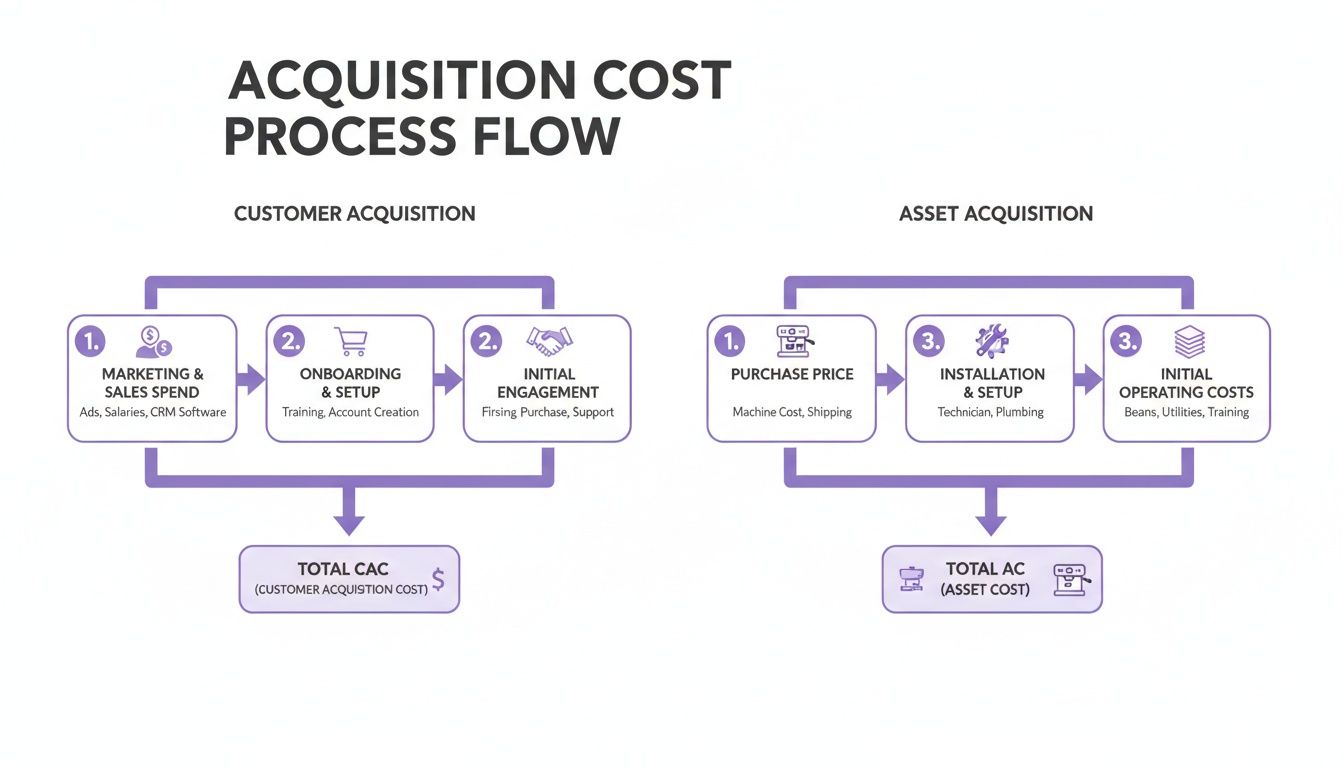
As you can see, it clearly separates the operational expenses that drive customer growth from the capital investments that build your business's infrastructure.
A Practical CAC Calculation Example
Here's a concrete example. Say a SaaS company spent the following in Q3:
- Ad Spend: $15,000
- Marketing & Sales Salaries: $40,000
- Software Subscriptions: $5,000
Their Total Spend for Q3 comes out to $60,000. During that same three-month window, they brought on 200 new customers.
Plug those numbers into the formula: $60,000 ÷ 200 = $300 CAC
This means the company spent, on average, $300 to acquire each new customer. If you want to confidently and accurately measure your own CAC, this customer acquisition cost calculator guide is a great resource.
The LTV to CAC Ratio
CAC becomes more useful when you compare it to your Customer Lifetime Value (LTV). LTV is the total revenue you can reasonably expect from a single customer throughout their entire relationship with your company.
The LTV:CAC ratio is the key indicator of your business's sustainability and profitability. For many industries, a healthy benchmark is 3:1, meaning for every dollar you spend acquiring a customer, you generate three dollars back in lifetime value.
If your ratio is dipping below that, it might be a red flag that you're overspending. But if it's way higher? That could be a sign you're not investing enough in growth and are leaving money on the table.
Why Your Industry Defines Your Acquisition Costs
There's no universal "right" number for acquisition costs. A "good" acquisition cost is a benchmark shaped almost entirely by the industry you're in.
Think about it. The cost to get a new customer for a local coffee shop is worlds away from what it costs a global enterprise software company. One might rely on a sandwich board and a good location, while the other navigates a months-long sales cycle involving demos, legal reviews, and multiple VPs. Understanding where you sit is the first step toward setting a realistic budget.
What looks like a terrifyingly high CAC in one space might be a bargain in another. Comparing your numbers to an unrelated industry is a surefire way to make bad strategic bets.
High-Stakes Spending in B2B SaaS
The Business-to-Business (B2B) Software as a Service world is a prime example of a high-cost environment. Companies here are often selling complex, high-ticket products that demand a ton of education and trust-building before anyone signs on the dotted line.
This isn't a quick click-and-buy transaction. The sales process is a journey, often involving:
- Long Sales Cycles: It can take months of nurturing to turn a curious lead into a paying customer.
- Multiple Stakeholders: You need buy-in from developers, product managers, and C-level executives, all at the same time.
- In-Depth Demos: Prospects need personalized walkthroughs and technical deep dives to really get the value.
This high-touch approach naturally sends costs soaring. In the SaaS industry, where a company like Brand.dev operates, the average customer acquisition cost has climbed to $702 per customer. That's a staggering 222% jump over the last eight years, a sign of just how competitive the space has become. You can find more details in these SaaS acquisition trends.
The Fast-Paced World of B2C Ecommerce
B2C ecommerce operates differently. The goal is still acquiring customers, but the path is shorter and more direct.
In B2C, volume is the name of the game. Success often hinges on high-visibility advertising, impulse buys, and a checkout experience so smooth you barely notice you've spent money. The focus is less on building a long-term relationship and more on getting that immediate conversion.
But just because the CACs are lower doesn't mean it's easy. The main cost drivers here are the relentless bidding wars for ad space on platforms like Google and Meta. Plus, your budget is tied directly to your average order value (AOV). A brand selling $20 t-shirts has a much tighter leash on acquisition spending than one selling $500 electronics.
Understanding your industry's financial landscape matters. It's how you benchmark your performance accurately, allocate budget effectively, and understand the pressures that shape what it costs to grow your business.
The Hidden Leaks That Inflate Your Costs
Knowing your CAC is the first step, but the real work starts when you have to figure out why that number is so high. Often, acquisition costs don’t balloon because of one catastrophic failure. They creep up because of a series of small, hidden leaks in your growth strategy.
These tiny inefficiencies quietly drain your budget, making profitable growth feel like an uphill battle.
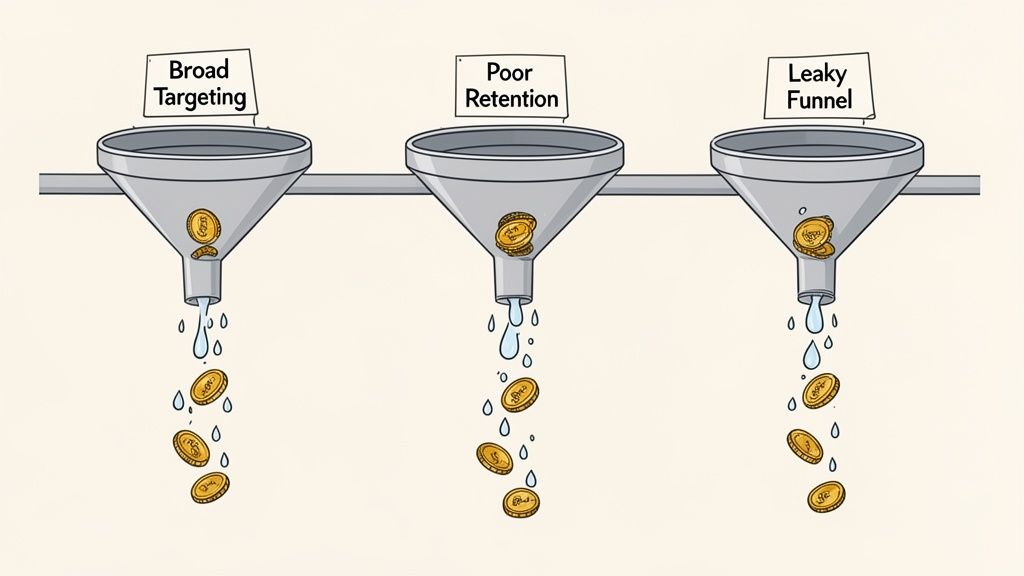
It's like trying to fill a bucket with holes in it. You can keep pouring more water in (i.e., cranking up your ad spend), but you'll never fill the bucket until you plug the leaks. Pinpointing these problem areas is your key to a more efficient growth model.
The Problem of Targeting Everyone
One of the most common ways to burn through a marketing budget is casting the net too wide. When you try to appeal to "everyone," you usually end up connecting with no one. This shotgun approach wastes money on clicks from people who were never going to be the right fit for your product anyway.
Imagine a fintech app marketing itself to the general public. It sinks thousands into ads that reach college students, retirees, and small business owners. The app gets a ton of traffic, sure, but its conversion rate is abysmal because its core features were built for one group: freelance creatives.
A much smarter play is to narrow the focus. By targeting only freelance designers, writers, and consultants with messaging that speaks their language, the app’s ad spend suddenly becomes incredibly effective. Every dollar is now aimed at a high-intent audience, which dramatically lowers the cost to acquire each ideal customer.
Forgetting About Your Existing Customers
So many companies get obsessed with the thrill of chasing new customers that they completely neglect the ones they already have. This is a massive, costly mistake. It’s an old marketing adage for a reason: retaining an existing customer is far cheaper than acquiring a new one.
Some studies suggest it’s five times more expensive to attract a new customer than to keep a current one happy.
When you fail to invest in great customer service, a smooth onboarding experience, or loyalty programs, you create a revolving door. Customers sign up, get confused or frustrated, and then churn. You’re then forced right back into the expensive acquisition game just to replace them. It's a spending treadmill that never leads to real growth.
A high churn rate is a direct tax on your acquisition budget. Every customer you lose is another one you have to pay to replace, effectively forcing you to re-acquire the same spot in the market over and over again.
Letting Leads Slip Through a Leaky Funnel
Finally, you can lose countless potential customers to a clunky or confusing sales process. A "leaky funnel" is what happens when friction points in the customer journey cause prospects to give up and drop off right before they convert.
These leaks can be anything:
- A slow-loading website that tests everyone's patience.
- A confusing checkout process with way too many steps.
- A signup form that asks for your life story upfront.
Each one of these friction points is a hole in your bucket, letting valuable, high-intent leads escape. You've already paid to get them to your site; losing them at the last second means that entire investment goes down the drain. Fixing these small leaks can have a massive impact on your acquisition costs without you ever having to spend another dime on advertising.
Practical Strategies to Lower Your Acquisition Costs
Knowing your acquisition costs is half the battle; the other half is doing something about it. But lowering your costs isn't about slashing your budget into oblivion. It’s about spending smarter and building a more efficient growth engine.
These are proven strategies that can genuinely lower your acquisition costs without killing your momentum. The common thread? Creating a frictionless, more valuable experience for potential customers. Small improvements at key moments can lead to significant savings down the line.
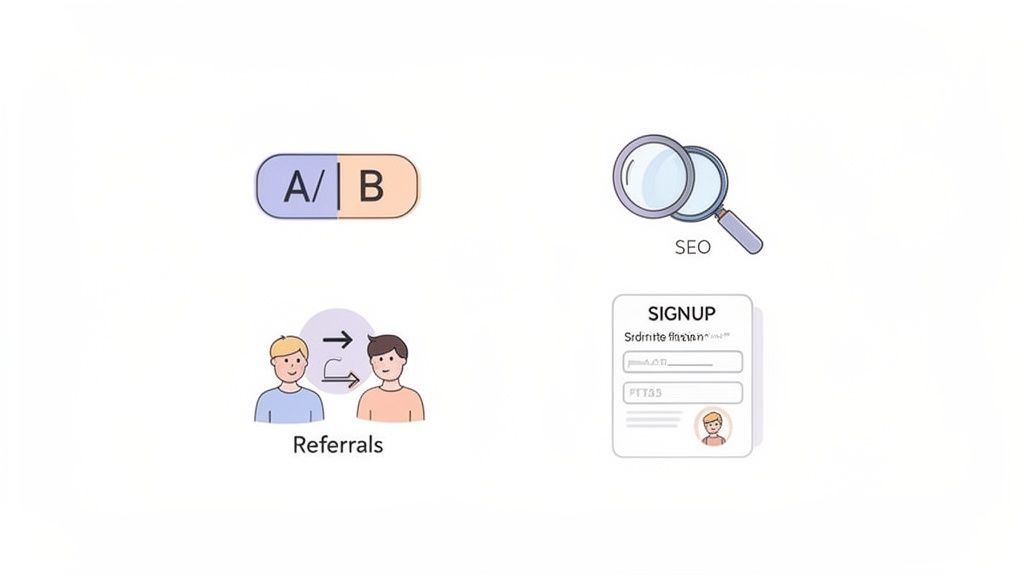
Here's how to get more from every dollar you spend.
Optimize Your Conversion Funnel
Think of your website and signup process as your digital storefront. Even the slightest bit of friction here can cause high-intent prospects to drop off, wasting the money you spent to get them there in the first place. The goal is simple: make saying "yes" as easy as possible.
You get there through a process of continuous improvement:
- Run A/B Tests: Stop guessing what works. Test different headlines, calls-to-action (CTAs), and page layouts to see what truly resonates with your audience and drives them to convert.
- Simplify Forms: Is every single field on your signup form absolutely necessary? Each extra box is another excuse for a user to give up. Keep it minimal.
- Improve Page Speed: We live in a world of instant gratification, and a slow-loading site is a conversion killer. Optimizing your site's performance is low-hanging fruit with a massive impact.
The smoother the journey from prospect to customer, the more efficient your acquisition spending becomes.
Build Long-Term Assets with SEO
Paid advertising delivers results now, but it's like renting an audience. The moment you stop paying, the traffic stops. Search Engine Optimization (SEO), on the other hand, is like buying. It’s an upfront investment in creating valuable content that builds into a long-term, compounding asset.
By ranking for relevant keywords, you attract a steady stream of high-intent visitors organically. This "free" traffic builds on itself over time, steadily decreasing your reliance on paid channels and lowering your blended acquisition costs.
This strategy requires patience, but it pays dividends for years to come. It’s a foundational piece of any sustainable growth model.
Turn Customers into a Growth Engine
Your happiest customers can be your most powerful, and most cost-effective, acquisition channel. A well-designed referral program transforms your existing user base into a motivated sales force, bringing in new customers who already have a trusted recommendation.
For example, ecommerce businesses often see an average CAC around $70-$78, but that can skyrocket to $120 in competitive sectors like electronics. US brands on the West Coast frequently pay 15-25% more due to fierce ad competition. Incentivizing referrals is a proven way to bypass these rising costs. You can learn more from these ecommerce acquisition cost benchmarks.
Personalize the Onboarding Experience
A generic welcome is a huge missed opportunity. Tools like the Brand.dev API can dramatically lower CAC by removing friction and boosting engagement from the very first interaction. By using first-party data sources, you can create a truly memorable experience. To dive deeper into the data types, check out our guide on first-party vs. third-party data.
Consider these direct impacts:
- Prefilled Signups: Automatically pull in a new user's company logo and brand information just from their email domain. This small touch eliminates manual entry, speeds up the process, and immediately shows off the power of your product.
- Personalized Onboarding: Instantly theme a new user's dashboard with their company colors and assets. This creates a familiar, welcoming environment that boosts engagement and cuts down on early-stage churn.
- Streamlined Marketing: Automatically generate on-brand assets for marketing campaigns, saving countless hours and ensuring a polished, professional look across all channels.
By making that initial experience seamless and deeply personal, you increase conversion rates and the likelihood that new users will stick around, directly improving both your CAC and LTV.
Building Your Path to Sustainable Growth
This isn't about pinching pennies. It's about building a smarter, more sustainable growth engine for your business. Acquisition costs are a dynamic indicator of business health, not just a static number on a spreadsheet.
When you nail the fundamentals, calculate your metrics with confidence, and execute on smart strategies, you stop seeing acquisition costs as an expense. They become an investment. Using tools like Brand.dev to sharpen the customer journey is a perfect example of this in action. When you build a business where the value you get from each customer consistently dwarfs what you spent to win them over, you've found the real path to lasting success.
The ultimate aim is to create a business where the value you gain from each customer consistently and significantly outweighs the cost to acquire them. That is the essence of a healthy, scalable model.
By focusing on efficiency and real value, you build a growth machine that thrives. For those ready to take the next step, a strong demand generation strategy creates a predictable pipeline of high-quality leads.
Frequently Asked Questions About Acquisition Costs
Here are answers to common questions about acquisition costs.
What Is a Good LTV to CAC Ratio?
The benchmark for a healthy, scalable business is an LTV to CAC ratio of 3:1. This means you're generating $3 in lifetime value for every $1 you spend to acquire a new customer.
- A ratio below 3:1 (like 1:1) is a red flag. It suggests you’re spending too much to get customers and likely losing money on every new signup.
- A ratio way higher than 3:1 (say, 5:1) might seem great, but it can actually be a sign that you’re underspending on growth. You could be missing out on opportunities to scale faster by investing more in your sales and marketing channels.
How Often Should I Calculate My CAC?
The right cadence for calculating CAC really depends on what stage your business is in.
For startups and early-stage companies, calculating CAC monthly makes sense. Things are moving fast, and you need to be agile. A monthly check-in lets you see what’s working, kill what isn't, and pivot your strategy before you burn through your cash reserves.
Once you're more established and your marketing channels are stable, you can often switch to a quarterly calculation. This gives you a broader view of performance while still being frequent enough to spot important trends and adjust your budget accordingly.
What Is the Difference Between CAC and CPA?
While CAC and Cost Per Acquisition (CPA) sound similar, they measure different things. CPA measures the cost of a specific action, while CAC measures the cost of acquiring a new customer.
CPA is more of a micro-metric. You can have a CPA for anything: a lead magnet download, a free trial signup, a newsletter subscription, or even just an ad click.
CAC is the big picture: It rolls up all your sales and marketing costs and zeroes in on one final outcome, the total cost to land a paying customer. A single customer's journey is often made up of several different CPA events before they finally convert.
Ready to slash your CAC by creating frictionless, personalized onboarding experiences? With Brand.dev, you can automatically prefill signups with company logos, theme dashboards with brand colors, and generate on-brand marketing assets in seconds.